Water and Cat Health
Water – the source of life. :)
Cats are animals adapted to dry, water-scarce environments, and many wild feline species living on other continents have even evolved to survive in semi-desert conditions. Our domestic cats obviously do not live in such extreme habitats, but they retain the same physiological adaptations – an exceptional ability to concentrate urine and a remarkable tolerance to dehydration. I put the latter in quotation marks because it simply means that cats may show no obvious clinical signs even when dehydration reaches as much as 8% of their body weight. Unfortunately, these same adaptations are also responsible for many urinary tract problems. When the urinary system is chronically overworked, it is often one of the first body systems to suffer with age. In nature, cats obtain most of their water from their prey. In our homes, however, they are often fed predominantly dry food, which deprives them of this natural source of hydration.
A cat should consume approximately 55 ml of water per kilogram of body weight each day. For a 5 kg cat, this translates into around 250–275 ml of water daily. Of course, this does not have to come solely from drinking water, as the moisture contained in food also counts. How does this relate to diet? Dry food contains only about 8% moisture, meaning that 100 grams of dry food provides just 8 grams (8 ml) of water—only 8 ml out of the required 250 ml. A healthy 5 kg cat will not even eat 100 grams of a good-quality, high-meat dry food each day. Therefore, the remaining water requirement must be met by drinking directly from water bowls. Wet food, on the other hand, contains approximately 82% moisture, meaning that 100 grams provides 82 grams (82 ml) of water. Since cats usually consume considerably more than 100 grams of wet food per day, those fed exclusively wet diets obtain almost all of their daily water intake from their meals. However, this does not mean we can neglect providing fresh drinking water. The goal is not merely for the cat to drink enough to survive, but to remain truly well hydrated, allowing the bladder to fill and empty regularly. Furthermore, our cats do not always cooperate with the feeding regimen we would prefer. It is not always practical to feed only wet food without disrupting the cat's natural physiology and ethogram, which are based on consuming many small meals throughout the day. As a result, many domestic cats simply do not drink enough. So what can we do to encourage them to drink more?
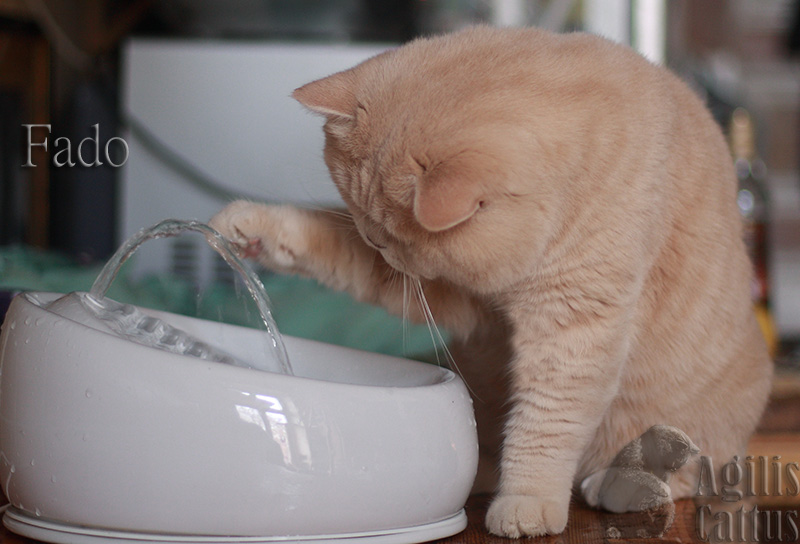
Cats are creatures of habit. They love their daily routines and repeated patrols around their territory. Water bowls should therefore be placed along these "routes"—in places where the cat naturally likes to stop—so that drinking becomes almost effortless. There should be plenty of them, and not only on the floor. Cats experience their world in three dimensions, and many of their favourite locations are above ground level. We should also provide a wide variety of drinking vessels, from wide, shallow bowls to tall, narrow glasses, placed throughout the home—on the floor, on windowsills, or on pieces of furniture the cat enjoys. Many cats prefer drinking without lowering their heads and will happily choose tall, narrow or wide containers, although individual preferences vary considerably. Cats are also naturally attracted to moving water, which is why purchasing a drinking fountain can be an excellent way to encourage hydration. There is no need to worry that they will become dependent on this single water source (I used to worry about that myself), because if a variety of well-placed bowls is available, cats will happily use different "watering holes" during their daily rounds. However, it is worth choosing fountains carefully. Some look beautiful to us but are completely impractical from a cat's perspective. A fountain should be easy to disassemble and clean. In fact, it is best to seek advice from experienced cat owners regarding which models have proven popular and well accepted by cats.
It is also important to position water bowls correctly, especially those placed on the floor. They should not be pushed up against a wall (the same principle applies to food bowls). Cats like to be able to walk around a bowl before drinking from it—another little ritual—and they prefer to drink facing the room rather than with their backs to it, which makes perfect sense from a safety perspective. If a bowl is placed directly against a wall, some cats may refuse to use it altogether. Start by placing the water bowl in the middle of the room. If the cat drinks from it there, it is a good indication that the container itself is acceptable. You can then gradually move it to different locations until you and your cat reach a compromise—a place where your cat is still happy to drink and you are no longer tripping over the bowl. 
Finally, I would like to mention senior cats and those suffering from painful medical conditions. For these cats, providing elevated water containers is absolutely essential. Bending down to drink may be difficult or painful, meaning that such cats may only drink when their thirst becomes stronger than the pain—and by then they are already seriously dehydrated. Remember that the less wet food your cat eats, the more important it becomes to maximize voluntary water intake. This is crucial for maintaining a healthy urinary system. For some cats, such as the one shown in the video at the bottom of this page—a cat born with a cleft palate—the right choice of drinking vessel can literally make the difference between life and death.

Dorota Szadurska, COAPE Centre of Applied Pet Ethology Behaviourist and Studium Kot
Graduate of the Animal Psychology Programme, Polish Academy of Sciences