Cat Starter Kit and Essential Cat Supplies
Cats are often considered low‑maintenance animals, but this is not entirely true, and you should be prepared for certain additional expenses. What’s more, with every new cat joining the household, another “starter kit” should come along—cats do not necessarily want to share items they’ve already claimed as their own.
The basic equipment for our cats includes a bed (although this is not always necessary—my cats sleep in various places, usually those intended for humans, but they also have their favorite beds they return to regularly), a litter box, a scratching post, and a carrier for transporting your cat, for example to the vet. You should also allocate a significant portion of the cat budget to toys (a necessity, not a luxury!). Additionally, bowls, grooming brushes—especially for long‑haired breeds—are essential. Future vet visits, regular vaccinations, and similar expenses will also play a major role. These costs should never be underestimated, regardless of whether your cat is purebred or not. Choosing to have a cat is, in a way, choosing to care for a child that will never grow up and will always need your attention. I don’t mean just feeding, but daily interaction, play, and engagement. It’s worth remembering this when welcoming a cat into your home, no matter its background.
Cats are quite special animals—once one moves in, we often find ourselves wanting another, and then another. This is absolutely possible, but with each additional cat, we must consider expanding and adapting our living space so they can create their own areas within the home. A simple extra set of “scratching post – litter box – bed” is not enough. I recommend reading the section Cat in the Home, where I describe the changes needed to ensure a happy, relaxed cat—an essential read if you’re considering a second or third cat.
Carriers
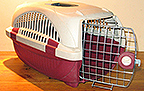 A good carrier is perhaps the most important piece of equipment for keeping your cat safe. A cat in a carrier can travel safely by car, plane, bus, taxi, or train. The market offers a huge variety of carriers in different sizes and materials. The choice depends primarily on the mode of transport you use most often, but you should always pay attention to how the carrier opens—I believe that regardless of the material, a carrier should have a top‑opening option. This is extremely useful when removing a cat in places where it feels uncomfortable, such as at the vet. FABRIC CARRIERS are attractive and definitely more convenient when traveling by train and carrying luggage—they are simply lightweight. However, they have a major drawback: they do not protect against mechanical injury. Some fabric carriers lack internal reinforcement, and collapsing walls can be terrifying for a cat. Soft walls also offer little protection against claws. If the carrier falls or someone drops something on it, the cat is completely unprotected. Fabric carriers are indispensable in certain situations—if you don’t have a car and walk frequently, the weight of a plastic carrier can be a burden. They are also useful for air travel, but only in the “in‑cabin” version, not in the cargo hold (I can hardly imagine leaving a cat among suitcases…). They meet airline size requirements, and their low weight works in your favor—airlines charge based on the total weight of the cat and carrier. It’s definitely good to have one fabric carrier for situations when a car isn’t an option—but even then, it’s important that the bag isn’t flimsy and has internal reinforcement to prevent the walls or roof from collapsing. Some versions come with backpack straps—very convenient, but again, reinforcement is essential.
PLASTIC CARRIERS are, in my opinion, the best choice. One carrier will last a cat a lifetime (provided it’s the right size). They are heavier, but if you don’t have a car, you can choose a smaller model—some cats even feel more comfortable in compact “dens.” Pay attention to the lock—it should be secure enough not to open accidentally. A very useful feature is an additional top‑opening door. Sometimes, especially at the vet, a cat simply refuses to come out—lifting it from above is easiest for us and least stressful for the cat, far better than “shaking” it onto the table. Of course, all carriers can be disassembled, and you can remove the entire top, but this is more complicated. If you can buy a carrier with a top‑opening option, I strongly recommend it. Another important aspect is ventilation—the carrier should not be too enclosed, so the cat doesn’t feel suffocated. It should also have no protruding internal elements to minimize injury risk during sudden braking. A plastic carrier is definitely the best solution for cat owners who travel by car.
Scratching Posts
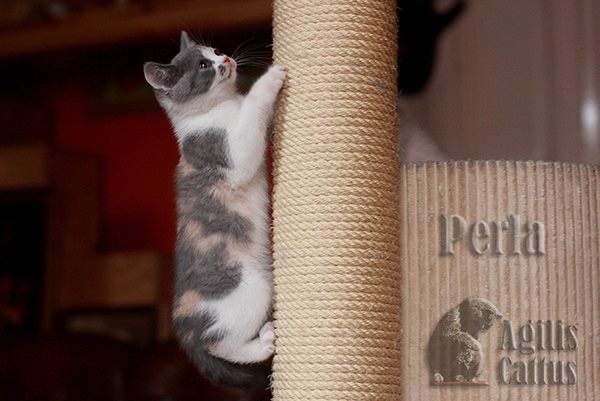 A scratching post is an essential part of a cat’s world. A well‑designed one allows climbing, observing the home territory, and serves as an important place for territorial marking. This topic is so important that I’ve described it in a separate article, available here: Scratching Post for Cats
Litter Boxes
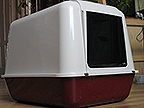 A litter box is absolutely essential, and choosing the right one is key to your cat’s comfort. The number of litter boxes in your home should equal the number of cats, plus one. Even with one cat, it’s worth planning space for a second box. Litter boxes vary in size and depth. Never buy a litter box sized for a kitten—British Shorthairs, especially males, grow quite large, and for a cat to use the box comfortably, it must be able to turn around and stand upright, especially in a covered box.
Litter boxes come in two types: covered (with a top) and uncovered. Covered boxes are excellent from the owner's perspective — they prevent litter from spilling out when cats bury their “treasures” enthusiastically and look aesthetically pleasing. Manufacturers claim they reduce odor. However, I am against closing covered boxes completely—the stuffiness inside is unpleasant even with regular cleaning. Even our human toilets have proper ventilation. I use covered boxes, but all of them have the doors with fragments of the roof removed, ensuring proper airflow and humidity. I’m happy, because my very thorough digger, Arabica, doesn’t create little mountains on the floor.
Covered create another danger: when someone never checks the box and assumes that if they can’t see the contents, it must be clean—this can lead to shocking amounts of waste accumulating. And second, some cats simply refuse to use covered boxes. Fortunately, this is rare—removing the door usually solves the problem.
If your cat squats while urinating and doesn’t scatter litter everywhere, an uncovered box is enough. If the box has no lid, it’s good to choose one with an inward‑curved rim—it helps reduce litter spillage. The height of the box also matters—most are too shallow. Cats need about 5 cm of litter, and the sides must be high enough to prevent scattering. With uncovered boxes that have a curved rim, remember that the rim reduces usable space—so buy a slightly larger box. Otherwise, the cat may sit on the rim, and urine will flow outside instead of into the box.
Manufacturers constantly introduce new products—there are even automatic litter boxes that start a cleaning cycle after the cat leaves. They vary in design but share one feature: they temporarily make the box unavailable. They are also noisy. I’m not sure a cat wouldn’t be afraid to enter such a machine—but perhaps I’m exaggerating, as my cats have never used one.
And one more thing—people often ask whether a cat can be trained to use a human toilet. Yes, it is possible (some companies even sell special training kits), but I strongly urge you not to follow this trend. This method is completely against feline physiology and the natural elimination ritual. Cats have a strong instinct to dig a hole and bury their waste. The instinct is so strong that cats try to dig even in an empty litter box—and they attempt the same on a toilet seat. Not to mention the balance required. Sure, we humans can manage in a public restroom “hovering,” but would you want to do that every time? I certainly wouldn’t. Additionally, observing your cat’s stool and urine output is crucial for detecting health issues—often the first signs something is wrong. Please don’t follow such trends. Cats are intelligent and learn quickly, but we should not force them into behaviors that contradict their nature.
Litter
Every year, new types of cat litter appear on the market, and the variety is now enormous. How do you choose the right litter for your cat? Usually, the cat will tell you—if it uses the litter willingly, it’s the right one.
Bentonite litter is very popular among cats. It comes in various textures, from coarse grains to fine sand. It’s very convenient because urine clumps into balls, which can be removed with a scoop while the remaining litter stays clean. However, remember that bentonite litter must not be flushed down the toilet. It is extremely easy to clean, doesn’t track much outside the box, and in my opinion absorbs odors best. But again—never flush it. Collect it in separate bags and dispose of it with household waste. Its biggest advantage is that almost all cats love it, and the more comfortable the litter box, the less likely the cat is to avoid it.
Another option is clumping wood litter, which can be flushed, but it is lightweight and easily carried out of the box on paws. More convenient for us does not necessarily mean better for cats. I used wood litter many years ago, but now I use only fine bentonite. Wood litter is often disliked by cats—perhaps due to sharp edges, or other reasons known only to them. Many cats merely tolerate it, which means they visit the box only when absolutely necessary—not good for their health. Holding urine leads to recurring bladder inflammation, and even minor emotional stress can cause litter box avoidance. Of course, many cats accept wood litter without issues—just observe how often your cat enters the box and whether it hesitates before going in. If so, try another type.
There are also silica gel litters, and although many caregivers like them, I believe they should not be used in cat litter boxes at all.
Dorota Szadurska, COAPE Behaviourist Supervisor
Graduate in Advanced Diploma in Feline Behaviour Management (Level 5, UK)
Graduate in Animal Psychology, Polish Academy of Sciences, Warsaw
Member of The International Society of Animal Professionals
Member of The International Association of Animal Behavior Consultants