A Cat-Friendly Home: What Does "Catification" Really Mean?
Cats have a reputation for being remarkably undemanding animals and, as a result, are increasingly chosen by people who, for various reasons, cannot have a dog. A dog, as everyone knows, needs to be walked, trained, house-trained and appropriately socialised and raised. Cats, by contrast, appear to be free from such "inconveniences": they sleep a great deal, do not need to be taken outside and, according to a frequently repeated misconception, humans are useful to them primarily as food providers because cats supposedly become attached only to places rather than to people. This way of thinking often results in a cat arriving in a home that is entirely unprepared to meet its behavioural and environmental needs.
It is certainly true that the environment is of fundamental importance to cats, although it is entirely untrue that humans are irrelevant to them. Cats form attachments to their human caregivers no less meaningfully than dogs do, and these relationships are individual and differentiated rather than identical with every member of the household. A cat may recognise the footsteps of a favourite person and wait by the door, even abandoning a much-loved nap to do so — and very often, this is not the person responsible for filling the food bowls. At the same time, the cat's physical environment and the spatial organisation of its territory are critically important to its welfare. They can determine whether a cat feels secure and confident or instead moves cautiously along walls and repeatedly retreats beneath furniture. Therefore, when considering adopting a cat, we should take a careful look at our home, try to view it from a feline perspective and ask ourselves whether we are genuinely prepared to make the necessary compromises to ensure that our cat can feel safe and comfortable living with us.
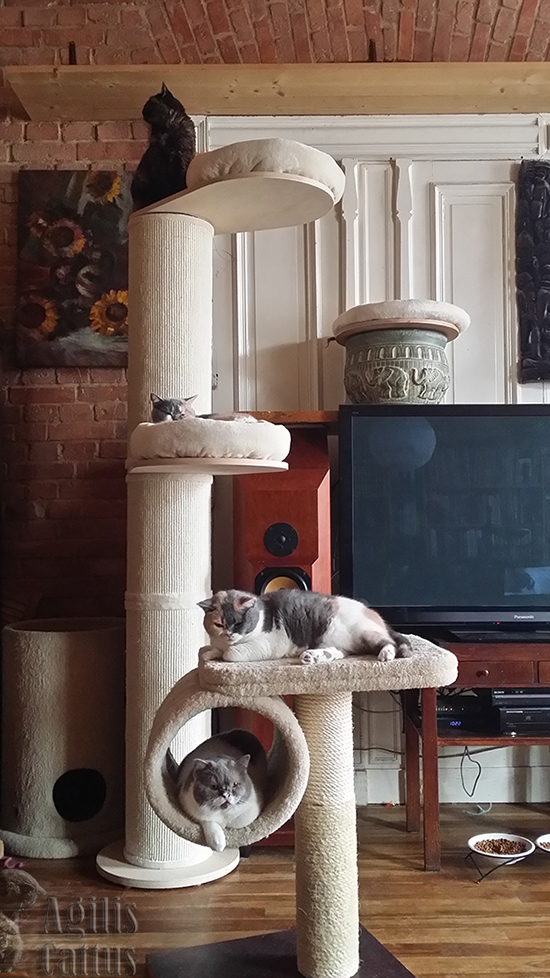
I will begin with the scratching post. Strictly speaking, I should write "scratching posts", but I would like you to keep reading until the end :) Scratching structures are extremely important components of a cat's environment. They enable cats to deposit both visual and scent signals, contribute to territorial marking and provide elevated locations from which cats can comfortably monitor their surroundings. I discuss scratching structures in greater detail in the Scratching Post for a Cat section.
Ideally, a scratching post or cat tree should form part of a larger, interconnected spatial route. If, for example, it is positioned next to a wardrobe or shelving unit, it is worth making these areas accessible to the cat as well, allowing the cat to move directly from the scratching structure onto them. Provide another element on the opposite side that allows the cat to descend, and you have created a functional route. In general, every elevated location accessible to a cat should also offer an alternative exit or "escape route". It is worth examining our homes from precisely this perspective.
If we can organise the environment by incorporating scratching structures, furniture and shelves in such a way that a cat can move around, if not the entire room then at least half of it, without touching the floor, we have created a particularly cat-friendly space. This does not always require increasing the number of scratching posts or cat trees. A system of shelves connecting wardrobes, shelving units or chests of drawers may be equally effective. However, designing a system of shelves is itself a challenge. Shelves should not be positioned randomly. If, from the cat's perspective, they function as "isolated islands" with no alternative exit route, they may not be perceived as sufficiently safe and the cat may simply choose not to use them.
A cat does not know that our home is an oasis of permanent peace and security. From the cat's perspective, it is a territory that could potentially be entered by an unfamiliar individual at any moment. Our cat therefore needs to have a strategy for such an eventuality. It needs an internal "road map" of the environment — a map organised according to feline behavioural priorities and perceptions of safety rather than according to human aesthetic preferences and assumptions.
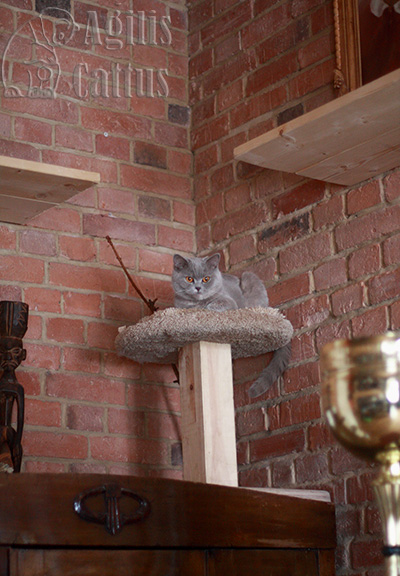
With every additional cat introduced into the household, an additional scratching structure should ideally be provided. This does not have to be a large or elaborate construction. What matters is the availability of a well-positioned, elevated and attractive resting site. No matter how extensive a cat tree may be, there is usually only one location that cats perceive as the most desirable. For this reason, I generally do not recommend purchasing a single, extremely elaborate cat tree. It is often preferable to buy two simpler structures that can be positioned independently or placed together, depending on the needs of the cats and the spatial arrangement of the home.
There is, however, an important consideration. If a cat tree forms part of an elevated route, we need to assess whether it could become a point of obstruction. Cats frequently choose the highest platforms as resting sites. If an occupied platform blocks the route, an alternative way around it should be provided. Very often, the design of the cat tree itself makes this possible. If another cat can bypass the occupied resting site by using a higher or lower platform, the route remains functional.
If the scratching structure is simple — consisting, for example, of a post and a single platform or hammock — and is intended to function as a connection between shelves or wardrobes, an additional route may need to be created. Ideally, this secondary route should not be excessively comfortable, otherwise it may itself become another resting site and therefore another potential point of obstruction. The photograph on the right — or above this paragraph when viewed on a mobile device — illustrates a less-than-ideal solution. Ino is lying on the small platform and, by doing so, has become an obstacle to the other cats. They can move from one shelf to another by jumping over her, but not every cat will feel sufficiently confident to do this. Jumping down from the shelves onto the wardrobe, or moving from the wardrobe onto the shelves, is practically impossible in this configuration. I subsequently redesigned this area and, until recently, it looked as shown in the photograph below on the left: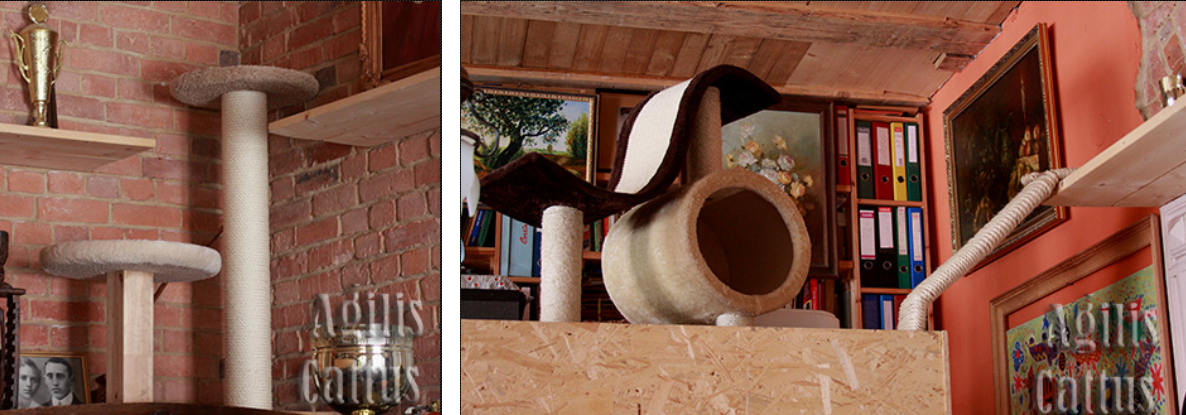
In the photograph at the top right, you can see a relatively small cat tree with an enclosed hideaway and a wave-shaped platform, both very popular with Borgia and Ino. The highest resting location is frequently used, as is the slightly lower one; the enclosed hideaway is used least often. To allow the cats to reach the shelf when the cat tree itself was occupied, I created a rather dreadful-looking access route, wrapping it in sisal rope for safety. It turned out not only to function perfectly as a bridge but also to serve as a feline "fitness club", as the cats love hanging from it and pulling themselves upwards :) Watching them perform these acrobatics is sometimes a little more than my nerves can comfortably tolerate, but the cats are clearly delighted with the arrangement.
Moreover, as enthusiastic practitioners of extreme sports, they love taking shortcuts and frequently jump directly from the bridge onto the highest part of the cat tree, or in the opposite direction. The latter is particularly stressful for me, although the cats invariably look extremely pleased with themselves. They race along the shelf towards the wardrobe or move across the cat trees visible in the photograph on the left, continuing towards another shelf and the sideboard. Regardless of the precise route they choose, if a cat is resting on the wave-shaped platform or inside the hideaway, several alternative routes remain available, allowing another cat to move from the shelf on the right towards the mezzanine. In the photograph below on the left, one of my female cats is lying on the lower level of the wave-shaped platform and does not obstruct movement from one side to the other.
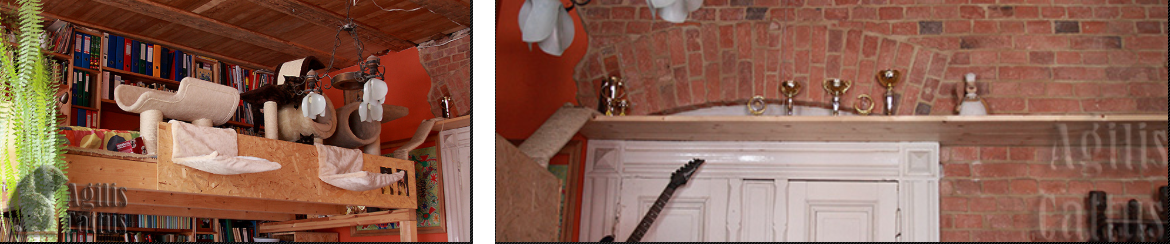
Another example of a route designed to minimise obstruction is shown below. A cat sleeping on the cat tree does not prevent another cat from descending from the shelf above the wardrobe, because the lower step provides an alternative route beneath the occupied resting site. I did not capture the entire arrangement in this particular photograph — it can be seen more clearly in others — but descending from the wardrobe is also possible when a cat is lying on the shelf. The lower step allows another cat to reach the shelf positioned immediately below and adjoining the wardrobe.
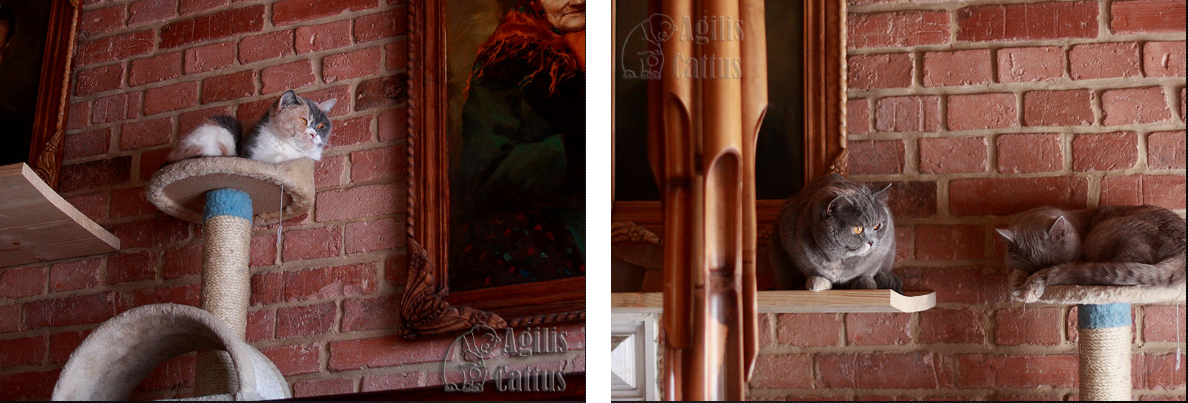
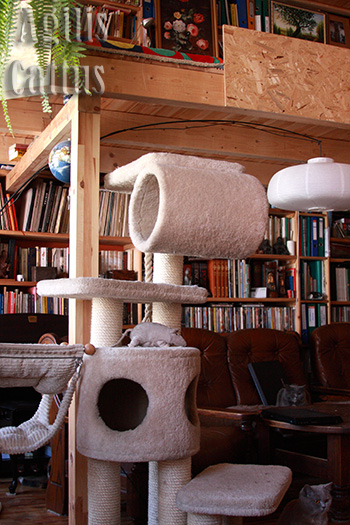
The spatial organisation of the environment becomes particularly important when more than one cat lives in the household. In some cases, appropriate environmental design is essential even for a single cat. Some cats are highly fearful or behaviourally inhibited and, in the absence of appropriately arranged elevated structures and safe observation points, may become increasingly withdrawn. At the sound of the doorbell, they retreat beneath a sofa or wardrobe; almost every unfamiliar person becomes a source of intense fear, and the cat hides wherever it feels safest.
Very often, once the environment has been modified to provide appropriate vertical space, elevated refuges and predictable escape routes, the same cat responds to the sound of the doorbell quite differently. Instead of disappearing beneath furniture, it may simply jump onto the highest shelf and observe the "intruders" from a location it perceives as safe. The external event has not changed. What has changed is the cat's ability to control its distance from the perceived threat and to choose an effective coping strategy.
When more than one cat lives in the home, an insufficient number of attractive locations and poorly organised access routes can contribute to intercat tension and conflict. The skirmishes and confrontations that occur between cats are frequently misidentified as play. Even when caregivers recognise that an interaction probably no longer resembles play, another explanation is often offered — one that I personally strongly dislike — namely, that the cats are "establishing a hierarchy".
Many guides recommend leaving the cats alone to "sort things out", an approach I find unacceptable. It is rather like allowing children in a sandpit to fight over a favourite toy. Children, too, could quickly "establish a hierarchy" and reinforce it whenever another attractive toy appeared. Cats do not form rigid, linear dominance hierarchies in the way this popular interpretation suggests, nor do individuals within a domestic cat group necessarily occupy fixed roles or permanent social positions. They will, however, compete intensely for resources that they perceive as limited or insufficient. I emphasise: that they perceive as insufficient. Unfortunately, it is not we who determine whether the number or distribution of resources is adequate from a feline perspective.
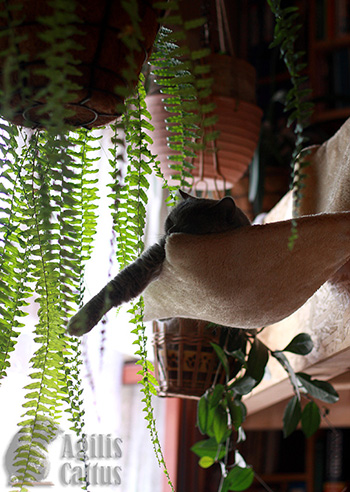 Because cats are territorial animals, they may compete for resources they perceive as valuable when access to those resources appears limited. In other words, if a cat tree provides one particularly attractive resting site at the very top, there may be no difficulty in a single-cat household. With two cats, however, competition may emerge. Of course, we may be fortunate enough to have an exceptionally compatible pair who happily curl up together on that single platform, but this is not something we should automatically expect.
Sometimes the resource that one cat begins to control is a litter tray. The cat may wait for another cat near the entrance and ambush it, preventing the other individual from accessing or leaving the toileting area without disturbance. Competition and resource control can involve a wide range of resources — even our laps. Importantly, relationships between cats may differ depending on the particular resource involved. A cat that consistently secures priority access to a specific resting site may yield to another cat near food or in a completely different context. The outcome depends on the "object of dispute", its perceived value and its importance to the individual cat.
The more cats living in a household, the greater the number and variety of attractive resources that should be provided from the cats' perspective. At the same time, the physical environment should allow individuals to move through shared space, avoid one another when necessary and pass without repeatedly being forced into close proximity. In a multi-cat household, environmental design is not simply about providing more objects. The distribution, accessibility and spatial relationship between resources are equally important.
The fact that a cat is missing something important to its welfare does not always manifest as pushing, fighting or overt aggression. Frequently, what happens is much less obvious. A cat may simply stop using a location that it strongly desires but which, for some reason, has become associated with frustration, uncertainty or the risk of confrontation. This is often misinterpreted with the simple statement: "My cats don't need it; they don't like it."
The truth is that what cats frequently avoid is not the resource itself but the potential for direct confrontation associated with accessing it. In order to reduce the risk of conflict, a cat may begin to avoid the cat tree altogether. This does not make the cat tree any less necessary or desirable. A cat that withdraws from competition for the most attractive location on the only available cat tree may become excessively quiet, appear resigned and reduce its general level of activity. Reduced movement may, in turn, contribute to weight gain and obesity. The scenario can be remarkably similar to what occurs when an insufficient number of litter trays is provided: there may be no overt aggression and no visible confrontation. Superficially, everything appears to be fine...
Another way of organising feline movement when the only available surface is a wall is to create a system of shelves. The same principles discussed earlier apply here. Every location should be assessed in terms of access, exit routes and the ability of cats to pass one another without direct confrontation. The shelves can be arranged in overlapping routes, with distances between them selected so that one cat can jump over another resting on a shelf or use an alternative route beneath it. If these factors are not taken into account, cats may begin to block one another's movement.
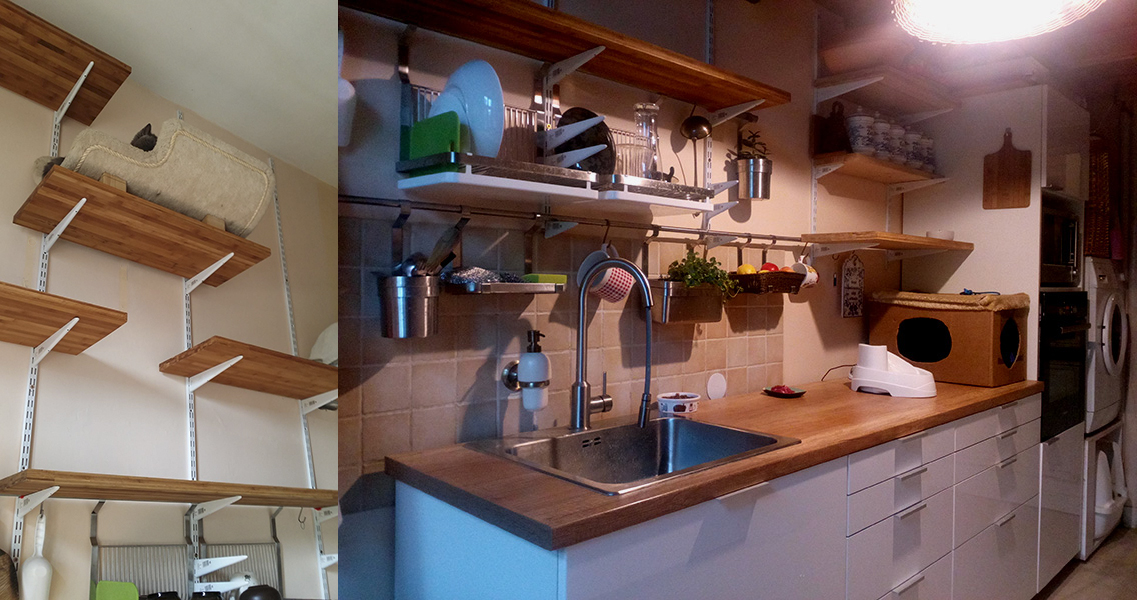
Modern homes often feature elegant, spacious and minimalist interiors. Smooth flooring — and it is worth remembering that slippery surfaces may adversely affect feline locomotion and can place additional strain on the musculoskeletal system, particularly when a young cat repeatedly loses traction and its limbs slide laterally — smooth walls, an elegant coffee table and sofa in the living room, perhaps a scratching post nearby: everything aesthetically coherent and genuinely beautiful.
From a feline perspective, however, such interiors may be extremely impoverished. They can lack structural complexity, vertical space, opportunities for concealment, elevated observation points and meaningful environmental choice. As a result, some cats do not feel secure in them. They may remain chronically vigilant, display persistent tension and have difficulty fully relaxing.
They become what I call "bathroom cats". When I receive messages from caregivers describing a cat that does not want to spend time with them and whose favourite resting place is the bathroom sink, I can usually imagine what the rest of the house or flat looks like. Of course, a cat has every right to want some time away from us — even in the bathroom. However, if the bathroom becomes the cat's primary refuge or sanctuary, this should prompt us to consider whether the wider environment is failing to meet some of the cat's behavioural and spatial needs.
This environmental deficiency can become considerably more problematic when another cat is introduced into the household. At that point, feline frustration, insecurity and competition for access to preferred locations may become much more visible and much more distressing — both for the newcomer and for the increasingly desperate caregiver.
I know that my high-ceilinged flat makes creating vertical space somewhat easier. However, virtually every home has unused space above doors and windows. In reality, the most important change often needs to take place in our own thinking if we genuinely want our cats to thrive in our homes. I am talking about cats that are truly comfortable, behaviourally active and able to express a broad range of species-specific behaviours — not cats that simply spend entire days asleep in an inaccessible corner.
Cats are curious animals and, when they feel genuinely secure and comfortable, most will not consistently choose to sleep hidden away inside a wardrobe. There are, of course, individual exceptions — cats are individuals, and some genuinely prefer more secluded resting locations. In many cases, however, cats choose resting places that allow them to assess their surroundings rapidly as soon as they open their eyes.
Simply placing a cat bed in a particular location is not enough to make a cat regard that place as safe, attractive or worth using. Cats select strategically important locations according to their own perception of safety, environmental control and access to information about their surroundings. This is why it is so important for our homes to provide a variety of options. The number and distribution of those options should increase as the number of cats in the household increases.
And most importantly, all of these principles apply to every cat, regardless of breed. They apply equally to our beloved adopted moggies, who deserve exactly the same love, attention and commitment to their welfare as their titled and award-winning pedigree relatives.
Dorota Szadurska, COAPE Behaviourist Supervisor
Graduate in Advanced Diploma in Feline Behaviour Management (Level 5, UK)
Member of The International Society of Animal Professionals
Member of The International Association of Animal Behavior Consultants