How to Introduce a New Cat into Your Home
 Cats are absolutely fascinating animals. They very quickly win the hearts of their caregivers, even those who describe themselves as committed "dog people" and admit to having had a rather low opinion of cats. Many years ago, I belonged to that group myself :) The truth is, however, that once we get to know cats more closely, we discover that human companionship is far from irrelevant to them. Cats form attachments to their caregivers, they miss them, and their humans matter to them for reasons extending far beyond the daily filling of food bowls. It is not the dog's almost constant readiness for interaction, but rather a quieter pleasure and a clearly expressed desire to remain in the presence of a beloved person: abandoning a nap in a favourite armchair simply because the caregiver has gone into the kitchen and therefore needs to be followed, enthusiastic greetings at the door, or settling down to sleep on the pillow beside our head. All of this means that, very quickly, one cat no longer seems enough.
We begin to think that, because our cat spends so much of the day asleep, they must surely be bored and in need of feline company. Caregivers often reach this conclusion after seeing how persistently their cat asks for play and attention. The decision to adopt a second cat, followed perhaps by a third and then another, appears simple and logical. The reality, however, is that cats are physiologically adapted to spend a large proportion of the day resting and sleeping. This is often precisely the time when we are at work. When we return home, the cat becomes involved in our life and seeks our company because it wants us, not necessarily because there is no other cat in the house. A second cat may simply mean that there are now two cats asking for our attention :)
Before you consider bringing another cat into your home, please read this article to the end, carefully weigh all the advantages and disadvantages, and make a genuinely thoughtful decision rather than acting impulsively after seeing an irresistibly adorable kitten. My intention is not to discourage anyone from living with more than one cat as such — I have ten cats myself and know perfectly well that more than one cat can live successfully in the same home. I simply want you to assess your chances of a successful introduction realistically and do everything possible to make coexistence easier for the cats.
Cats, unlike dogs, are not obligately group-living animals and are not social in the same way as dogs. They are territorial animals, which means that every newcomer entering the home may initially be perceived as an intruder. The strength of territorial responses varies considerably between individual cats. Some require a large area of personal space and find it extremely difficult to accept another individual within it; for others, their most strongly defended personal space may be limited to a favourite cushion by the window or their caregiver's lap. Depending on the strength of these territorial and resource-related responses, a cat may find it easier or more difficult to accept "the other one". This does not alter the fundamental point: the domestic cat is a territorial species and, with the exception of a small number of felid species such as lions, felids do not live in highly organised social groups. The arrival of another cat ALWAYS turns the resident cat's world upside down.What determines whether cats will accept one another? Unfortunately, there is no single, definitive answer to this question. Cats rely enormously on olfactory information, and sometimes one cat appears unable to accept another because the newcomer's individual scent profile is perceived as unfamiliar or threatening. Put very simply, the other cat does not "smell safe". Naturally, we have very little direct control over this aspect of feline perception. Some cats that were historically described as aggressive or incapable of accepting other cats may, in fact, have had abnormalities affecting olfactory or vomeronasal processing. The vomeronasal organ — traditionally referred to as Jacobson's organ — is involved in the detection of certain chemical signals. Difficulties in interpreting olfactory information may contribute to uncertainty and fear, and fear may in turn increase the likelihood of defensive or aggressive behaviour.
Cats that consistently flee and hide under furniture whenever visitors arrive may require particularly careful assessment before another cat is introduced. A cat is certainly under no obligation to approach or seek physical contact with every unfamiliar person. However, cats are naturally exploratory animals and many will, at some stage, investigate who has entered the home and what has changed. If visitors know that a cat lives in the house only because you assure them that one exists, this may indicate a particularly cautious or fearful individual and may be a less favourable prognostic factor when considering the introduction of another cat.
Unless, of course, the existing environment is simply too impoverished even for the resident cat. Sometimes increasing the usable three-dimensional space above floor level can dramatically improve a cat's confidence, and accepting another cat may then become considerably more realistic. I discuss environmental organisation, which is essential even in a single-cat household, in the "Cat-Friendly Home" section.
How Should You Prepare for Another Cat? What Does the Decision Actually Involve?
First of all, before expanding our feline family, we should consider whether we can afford it financially. I refer readers to the "Cost of Keeping a Cat" section, although, assuming that people reading this page already have at least one cat, this should theoretically be obvious. The cost of keeping a second cat does not usually increase mathematically by exactly 100%, but an increase of approximately 70–80% is certainly realistic. Litter consumption, vaccinations and routine veterinary examinations are fixed individual costs and these simply increase with every cat. There is little opportunity for saving here.
Food costs may work slightly differently. A second cat sometimes reduces food waste by enthusiastically eating whatever the first cat has rejected. Nevertheless, you must be prepared for food costs to double, or even discover that the new cat is more expensive to feed than the resident cat because of different food preferences, a different feeding method or a specific therapeutic diet.
The most important challenge is maintaining appropriate relationships between the cats. To support the welfare of more than one cat, additional litter trays must be provided as the number of cats increases. If the house or flat is large, the number of litter trays should exceed any simple mathematical formula — and this applies even when only one cat lives in the home. In a multi-level house or apartment, each floor should effectively be treated as a separate living area, which again means increasing the number of available litter trays.
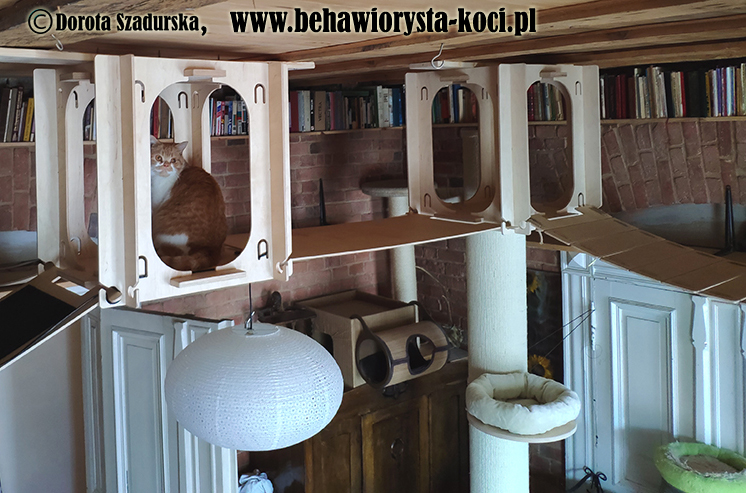
When it comes to resting locations, my practical guideline is approximately three attractive resting sites per cat. This is, of course, a simplification, but there should certainly be considerably more attractive resting places than there are cats. This does not mean that we must buy several additional cat trees. The aim is to make additional resting sites, shelves and existing furniture surfaces available and suitable for feline use — the top of a wardrobe or cabinet, for example. Ideally, these locations should form logical, connected routes along which cats can move without having to return constantly to floor level.
These are absolutely fundamental environmental considerations. Cats must be able to create psychological and spatial distance from one another and move around the home without being forced into close encounters. Without this, our chances of achieving peaceful coexistence between two cats are poor; with larger numbers of cats, the challenge becomes still greater. I use the word "peaceful" deliberately. Many people do not perceive competition for resting places, chasing or physical confrontations as a problem until "blood is drawn". I assure you that persistent social tension, displacement and competition are already serious problems from the cats' perspective and may contribute to chronic stress, behavioural disorders and impaired welfare.
Naturally, caregivers are delighted when cats lie close together. However, this may be less common than people imagine and does not necessarily demonstrate mutual affection. Sometimes both cats simply value the same location and no equally attractive alternative is available. One indication of this may be that one cat leaves the shared resting place relatively quickly. More information about planning a feline environment can be found in the previously mentioned "Cat-Friendly Home" section.
Another important element of multi-cat life is feeding. Ideally, cats should be fed from separate plates or bowls. One of the most serious mistakes made during introductions — and later in the everyday organisation of a multi-cat household — is the persistent attempt to make cats eat as close to one another as possible. Caregivers often interpret this as proof that the cats "like each other". Nothing could be further from the truth. Food is essential for survival, and even cats with extremely poor relationships may temporarily tolerate one another in order to consume a highly valued food item.
This does not mean that eating in close proximity is comfortable. For some cats, it may be extremely stressful. They may eat while highly tense, consume food excessively quickly or leave the feeding area prematurely. Food bowls should therefore be distributed throughout different areas or rooms. In fact, distributed feeding locations can be beneficial even in a single-cat household. The same principle applies to water: provide multiple water sources, using bowls of different shapes and heights and positioning them in different parts of the home.
One of the greatest forms of comfort we can offer a cat is access to individual space. This applies to resting and sleeping, but also to eating. We should therefore abandon the idea that feeding cats as close together as possible is desirable. The distance between feeding cats is not a reliable indicator of either a good or poor relationship, but forced proximity during feeding can certainly become a source of stress and frustration.
Many cats described by their caregivers as "fussy eaters" may actually leave the bowl too quickly because they are uncomfortable with another cat eating noisily immediately behind them. Such cats experience double frustration: the feeding environment is stressful and, in addition, they may not have eaten enough. Other cats respond to the same discomfort by eating excessively quickly simply to bring the unpleasant situation to an end. Cats require individual space not only for sleeping and elimination, but also for feeding. Please remember this. Distributing feeding areas throughout the environment can be extremely helpful during the introduction process.
The most important factor influencing the success of an introduction, however, is environmental organisation. There is no way around this. It cannot be replaced by pheromone products, "miracle" collars or — certainly not — the type of prolonged isolation that I personally dislike and do not recommend, in which cats are shut in separate rooms according to a timetable of partially opened doors or transported around the home in carriers. Expanding and restructuring the usable environment is absolutely essential if we want to give the introduction a realistic chance of success.
Cats must be able to observe one another from locations in which they feel safe, without being forced to meet exclusively at floor level, where they may need to pass dangerously close to one another simply to reach food or a litter tray. Unless we rebuild the resident cat's sense of security — which may be profoundly disrupted by the arrival of another cat — our chances of a successful introduction are limited. Prolonged confinement behind closed doors, repeated opening and closing of doors or carrying cats around in transport carriers will not compensate for an environment that fails to provide security and control.
No matter how long such procedures continue, cats may still respond negatively to one another if they remain chronically concerned about losing access to important resources. Naturally, at the beginning we provide the cats with separate areas of the home. However, these areas should be organised so that the cats can observe one another and regulate distance according to their own individual pace. I explain several paragraphs below how this can be organised and why I consider this type of spatial division so important.
Accepting feline nature for what it is is extremely important for cats' welfare and emotional wellbeing. I know that cats are wonderful. I know that, for many people, one cat is rarely the end of the story. I also know how much love the human heart can contain. A cat's tolerance for additional feline companions may not be quite so unlimited, and cats often need considerable help in learning to coexist with other cats in the home. Living with more cats means more responsibilities for us — very enjoyable responsibilities, certainly — but we must remember that a second cat is not a universal remedy for the first cat's boredom. If you are prepared for these challenges, for more cats waking you in the early morning and for the thunder of chasing paws to be considerably louder than you ever imagined, then perhaps you really are ready to welcome another cat into your family.Now for One of the Most Important Issues: Play Between Cats
It may, of course, be true that your cat is bored. However, I emphasise that we are responsible for providing appropriate activity for our cats, regardless of whether we have one, two or three. A bored cat may begin directing predatory or play-related behaviour towards another cat, particularly if it is physically stronger. I deliberately say "at the other cat's expense", because physical interactions between adult cats are not always mutually playful or equally rewarding. Cats do not necessarily engage in reciprocal social play in the same way as dogs, and physical contact may readily incorporate elements of predatory behaviour. This may be highly rewarding for the cat doing the chasing and grabbing, while being an equally significant source of stress for the cat being pursued.
Older kittens can also engage in very rough play, and personally I do not simply allow even young cats to continue every form of escalating physical interaction unchecked. Many people assume that cats play in the same way as dogs — wrestling, rolling over and tumbling together. The mechanisms and communication involved, however, are not identical. Dogs, as a highly social species, have an extensive repertoire of play signals and reciprocal behavioural adjustments that help maintain social play. Cats are extraordinarily serious creatures...
Adult cats do not necessarily play with one another, not in the way humans commonly imagine. Much of what we describe as feline play is closely associated with predatory motivation and predatory behavioural patterns. It is certainly enjoyable — but sometimes primarily for the cat doing the pursuing. I know that my interpretation of this issue is not universally shared. I also know that the myth of cats needing to "sort things out" and "establish a hierarchy" remains deeply rooted. But that is precisely what it is: an oversimplified myth, and for many cats it becomes a justification for tolerating distress and suffering.
We can interpret interactions between adult cats as mutually playful while both individuals remain able to control distance and disengage. One cat may chase another. The cat being chased may stop and turn around when the interaction becomes too intense. If the pursuing cat also stops, this is an important sign of behavioural responsiveness. Sometimes the cats exchange roles and chase in the opposite direction, again stopping when the other cat communicates that the interaction should pause. That is acceptable. If the interaction consists of two or three such short sequences in an open area and the cats then disengage and return to their own activities, the interaction is likely to be well regulated.
If, however, the pursuing cat fails to stop, jumps onto the other cat and pins it to the floor, the interaction has moved beyond comfortable reciprocal play. Biting — particularly biting directed towards the limbs — should not automatically be dismissed as "just play". It may certainly not be playful for the cat being bitten. The fact that "there is no blood" does not make the interaction harmless. At this stage we may be dealing with aggressive behaviour, predatory-like behaviour directed towards a conspecific, or a highly asymmetrical interaction causing significant distress to one participant. Whatever label we use, it requires careful assessment and should not simply be ignored.
A large proportion of feline play is predatory in structure, which means that an interaction may appear enjoyable while one cat is willing to take the role of the pursued individual. That willingness may disappear extremely quickly. Cats are, as I have already said, remarkably serious creatures, and the sound of another cat running immediately behind them can rapidly change an exciting chase into genuine fear. At some point the "prey" says: "Stop." If the pursuing cat does not respond, conflict may follow.
Unfortunately, the pursuing cat often fails to stop because its level of predatory arousal is already extremely high and the activity is intensely rewarding. Every chase therefore has the potential to escalate if the cats are unable to regulate the interaction themselves. Naturally, some pairs of cats exchange roles two or three times and then simply disengage. That is excellent. However, we should not assume that this always happens.
The predatory motivational system is extremely powerful. Once the predatory sequence has been activated — orientation and stalking ==>> visual fixation and targeting ==>> pounce and pursuit ==>> capture ==>> killing bite or sustained oral contact — some cats find it difficult to interrupt the sequence spontaneously. There is nothing morally "wrong" with this. It is feline biology. Some socially responsive cats are able to recognise the other cat's signals and stop when the pursued cat stops. In my experience, however, this level of self-regulation should never simply be assumed.
We can help our cats by organising the environment appropriately: making the tops of furniture accessible, installing shelves and creating elevated structures that function as behavioural "junctions". If the pursued cat can jump onto another level, change direction or move behind a visual barrier, the chase will often lose momentum naturally and end without escalating into physical contact. Open shelves may sometimes be preferable to enclosed boxes in this particular context. If the pursued cat enters a single enclosed hiding place, the pursuing cat may decide that the game has become even more exciting and begin "hunting through the hole", which can be extremely stressful for a cat that feels trapped inside.
To compare this with the human world, imagine a game of tag. You reach the designated safe place and shout: "Safe!" The person chasing you is expected to stop; they are no longer allowed to catch you. Now imagine that they ignore this rule, grab you, drag you away from your safe place, announce triumphantly that you have been caught and then sit on top of you. How would you feel and how would you respond?
For many cats, pursuing another individual is so rewarding that they effectively fail to respond to the other cat's "Safe!" signal. If the caregiver organises feline play appropriately — and play does not necessarily mean running, which is intrinsically highly attractive mainly to kittens and young cats — the cat's predatory motivation can be directed towards suitable objects. Once the need to stalk, pursue, capture and bite has been sufficiently fulfilled, we may even see brief affiliative interactions such as mutual grooming, after which the cats return to their own individual areas. These are moments of feline closeness, rather like a cat coming to us for physical affection. Some cats want more of it; others considerably less.
In a multi-cat household, we should always have an interactive wand toy, feathers or another suitable toy close at hand. If one cat becomes excessively aroused during an interaction, we can redirect the pursuer's attention and allow the predatory sequence to continue towards an appropriate object. It is important, however, that the cat is eventually able to capture and bite the "prey". For this reason, a laser pointer is not an appropriate substitute for physical prey-like toys when the aim is to provide completion of the capture phase.
When we play with a cat, we should offer something physical and tangible — an object the cat can catch with its paws, grasp with its teeth and "kill". Many guides state that a cat must always be fed immediately after predatory play. This is an oversimplification. The cat's predatory motivational system is not simply switched on and off by hunger. A cat may continue to seek predatory activity after eating. Predatory motivation and hunger are related in complex ways but are not identical motivational states.
Playing with more than one cat at the same time is an art in itself. Cats often appear to follow a rule similar to "the player with the ball has priority". In a relatively stable group, they may take turns interacting with the toy. One cat plays with the feathers while the second and third observe. The toy then moves away from the first cat and towards the second. If the second cat engages, the first will often temporarily disengage. The process can continue in this alternating pattern.
If there are tensions within the group, a cat that is uncomfortable with another individual may refuse to participate in this sequence. Alternatively, it may become irritated when the other cat joins the activity and withdraw from the entire interaction. Such a cat may need individual play sessions, or the caregiver must manage group play very skilfully while preventing the cats from being forced into close proximity. In practice, the cat is still playing "separately", even if all the cats are in the same room.
This can be difficult because socially confident cats may wait briefly for their turn and then approach to take over the activity, which may again irritate the less tolerant individual. The movement of the toy from one cat to another is important. If using feathers, lift them high above the cats' reach and move them rapidly towards the next cat at that height. If the wand toy remains sufficiently high, the cats are less likely to follow immediately. When they see the feathers return to floor level beside another cat, the "player with the ball" principle may operate briefly.
Cats that become irritated by the presence of others during play are often best given individual play sessions. Once alone, they may become visibly relaxed and animated, bouncing around like kittens.
Kittens make this more difficult because they rarely respect turn-taking. They charge headlong towards anything interesting, give nobody any breathing space and completely ignore the fact that the toy is currently being used by another cat. Two kittens of a similar age may manage this relatively well. The far more common introduction scenario, however — an adult cat and a kitten — can be a significant challenge. If there are two human caregivers available, we should usually be able to manage :)
Tolerating inappropriate or distressing interaction patterns allows them to become established and repeatedly rehearsed. Later, caregivers write to me asking for help because the relationship between their cats has "suddenly and unexpectedly" changed. In the overwhelming majority of such messages, the change turns out to have been neither sudden nor unexpected. It was simply an escalation of interactions the caregivers had observed every day but dismissed because "there was no blood".
The truth is that once blood is being drawn, the situation is already extremely serious. Our greatest opportunity to change the relationship exists before we reach that point. Even if physical injury never occurs, it may be difficult for caregivers to recognise the connection between a cat living in constant social tension — never knowing whether the other cat will approach, chase or disturb it — and recurrent, apparently inexplicable health or behavioural problems. Chronic stress can have profound effects on feline health and welfare, which I discuss in greater detail in the section on stress and its consequences.
How Should Another Cat Be Introduced?
Many people could describe many different introduction scenarios, ranging from the extremely simple — "I let the new cat out and everything was fine" — to introductions requiring several weeks or months of patient, structured work. My view is that we should prepare for the most difficult scenario. If we are fortunate enough to belong to the group of caregivers whose cats accept one another almost immediately, we can simply enjoy our good fortune.
1. Choose a time when the resident cat is in excellent physical and emotional condition. A new cat should not be introduced shortly after moving house, during a period of major changes in the household, soon after the birth of a baby, shortly after the resident cat has undergone neutering or another significant medical procedure, or immediately after returning from a stressful trip or holiday involving the resident cat.
Contact with another cat also means exposure to a different microbial environment. Every individual carries its own established microbiota and may have previous exposure to various infectious agents. The resident cat's microbial environment is unfamiliar to the newcomer, just as the newcomer's is unfamiliar to the resident. Stress associated with the introduction may affect immune function and increase susceptibility to clinical disease or contribute to the reactivation of latent infections. This does not automatically mean that either cat was "ill" or that the newcomer "brought disease into the house", although the new cat is very often blamed because everything appeared normal before its arrival.
I would compare this, very loosely, to travelling to another country and encountering unfamiliar microorganisms. The local population may have regular exposure to a particular microbial environment without becoming ill, while a visitor may respond very differently. Our cats also need to adapt to changes in their microbial and environmental exposure, which is one reason why good general health is so important before an introduction. The stress associated with moving home, encountering an unfamiliar cat and experiencing uncertainty within the resident cat's territory may all increase vulnerability to illness.
Any supplements or products intended to support immune function should be discussed with a veterinary surgeon rather than administered automatically. The priority is to ensure that both the resident and incoming cat are appropriately vaccinated, clinically healthy and assessed according to their individual age, history and risk factors.
Do not rely solely on a brief visual examination by a veterinary surgeon if there are reasons to suspect an underlying medical problem. Before a planned introduction — particularly in an older cat or a cat with behavioural changes — an appropriate veterinary assessment is essential. Depending on the cat's age, clinical history and examination findings, this may include haematology and serum biochemistry, thyroid assessment, urinalysis, diagnostic imaging and a thorough oral examination. Hyperthyroidism, pain, dental disease and many other medical conditions may alter a cat's behaviour and tolerance of environmental change. Any undiagnosed illness or pain may significantly reduce the resident cat's ability to cope with the arrival of another cat.
2. It is advisable to arrange several days off work during the initial introduction period. I strongly advise against simply releasing the new cat into the home and waiting for the cats to "sort it out themselves". Behaviours that we find difficult or unacceptable may occur during the early stages of an introduction and do not necessarily indicate that either cat is "bad". Cats may hiss, display piloerection or even growl. These responses communicate emotional state and the need for distance. However, repeated rehearsal and escalation of threatening interactions can be dangerous.
Initially, the cats will often need to be separated so that the newcomer can become familiar with at least part of the new environment and begin recovering from the stress of being removed from its previous home. In my approach, complete separation behind a solid closed door should generally be used only for a short initial period — perhaps one or two days — unless the individual cat's behavioural or medical circumstances require a different plan. A profoundly fearful or poorly socialised cat requires individual assessment before any attempt is made to introduce another cat.
My preferred introduction process involves dividing the home into zones separated by a secure mesh barrier. This allows the cats to observe one another safely and gradually learn how the other individual moves, behaves, vocalises and responds to the environment. They can discover that the other cat is not constantly doing anything threatening. I consider this much more informative than prolonged complete visual isolation.
Observation at the mesh barrier also allows us to assess whether the cats may be ready for carefully supervised sessions in shared space. In particularly difficult introductions, sections of the mesh can temporarily be visually covered while leaving small viewing areas, allowing the cats to observe while feeling less exposed.
Once the barrier is removed, we intervene and reinstate it if we observe behaviours such as persistent blocking, preventing passage, guarding access to a litter tray, waiting near a litter tray to ambush a cat as it exits, or repeated striking with the paws. In such situations, direct contact must be carefully managed. The cats may need periods of separation behind the mesh to reduce arousal and recover, and they should certainly be safely separated whenever nobody is present to supervise them.
Above all, however, we must identify the reason for the persistent monitoring, blocking or guarding. The mesh barrier will not solve the underlying problem. It is simply a management tool that helps prevent repeated negative interactions and gives us time to identify and address the primary cause. Very often, the underlying issue is inadequate environmental organisation or insufficient distribution of important resources. As I have already said, there is no way around this.
3. Synthetic feline pheromone products may provide additional support, for example a plug-in diffuser. They can be a considerable expense, but may be helpful for some cats, particularly the resident cat. The newcomer is often a kitten, and kittens may adapt relatively quickly to a new environment. Pheromone products should, however, be regarded as an adjunct rather than a substitute for appropriate environmental modification and behavioural management.
Anti-stress collars are also available, although I personally recommend them cautiously. The underlying problem during an unsuccessful introduction is usually stress, uncertainty or perceived threat, not a lack of "jewellery". Furthermore, some cats find collars sufficiently irritating that the collar itself may increase rather than reduce arousal.
4. Cardboard boxes can be remarkably useful during the introduction process. Place several boxes upside down in the room where you and the cats spend time — at least two or three, and more if several cats already live in the home. Cut two or three entrances into each box so that a cat can leave easily, and add narrow openings near floor level through which paws can reach.
More than one exit is essential. A box must not become a trap for a cat that enters while another cat waits at the only opening. The cat inside must always have an alternative escape route. Narrow openings near the floor may encourage paw-based interaction and allow relatively close contact while limiting the possibility of full physical confrontation. There should be several boxes because, as with every other valuable resource, a single box may simply become another point of competition.
5. Remember to devote plenty of time and attention to the resident cat. A new cat can be rather like a new baby arriving in a family. Everyone's attention naturally focuses on the newcomer. Everybody wants to play with and admire the adorable new bundle of fur. In reality, however, we need to pay particular attention to preserving the resident cat's established routines, activities and preferred interactions.
The arrival of another cat represents a profound disruption to the resident cat's carefully organised life. We should do everything possible to help the resident understand, through predictable daily experience, that life can continue according to a familiar rhythm — except that another individual now exists within the environment. The birth of a baby can create a similar sense of uncertainty and perceived threat in some cats.
6. Do not deliberately transfer scent between cats. In my approach, deliberate scent transfer is unnecessary, particularly rubbing the resident cat with a hand that has just stroked the newcomer, or using blankets and other objects specifically to apply the new cat's scent directly to the resident. Your cat has an excellent sense of smell and already knows perfectly well that another cat is present and what that cat smells like.
Dividing the home into zones separated by mesh allows the cats not only to observe one another's bodies, movement patterns, vocalisations and play behaviour, but also to associate each individual's scent with its actual source. We should allow cats to gather and process information at their own pace rather than repeatedly forcing olfactory exposure. For some cats, intrusive scent-transfer procedures may themselves become an additional source of stress.
7. Do not repeatedly confine cats in transport carriers or carry them around in carriers as part of the introduction. With an appropriately constructed mesh barrier, this is unnecessary. Many cats already have strong negative associations with being confined in a carrier.
So How Do We Separate Cats During the Initial Introduction Period?
Cats should not simply be released together and expected to "sort things out between themselves". Initially, they should have separate zones divided by a secure mesh barrier. Their behaviour at this barrier can tell us a great deal about how the introduction should progress.
If the resident cat simply observes the "intruder", very short, carefully supervised direct sessions may eventually be introduced. Afterwards, the cats are separated again so that they can recover from the interaction and their emotional arousal can decrease. I emphasise the word "eventually" and the phrase "relatively quickly" — I do not mean after two or three days. Direct contact should be considered ONLY after the environment has been appropriately adapted and the cats' behaviour indicates that they are ready.
If controlled meetings continue to end in attempted attacks or persistent predatory-like stalking directed towards the other cat, we return to barrier management and investigate why the problem remains. If difficulties continue after a month, this does not mean that the relationship should already be perfect. However, we should normally expect to see some meaningful progress. If, after a month, interactions at the barrier show no emerging neutral, tolerant or affiliative signals whatsoever, the suitability of the introduction itself should be considered very seriously.
Introducing another cat can also be emotionally difficult for caregivers, and your own psychological capacity to cope with genuinely unpleasant moments should be considered before bringing a second or additional cat into your home. The arrival of a newcomer often creates profound uncertainty in the resident cat. During the initial period, the resident may withdraw from caregivers, abandon established rituals, stop sitting on laps or sleeping in the bed, and may even hiss or growl at a beloved person whose clothes and body carry unfamiliar odours. Rebuilding the cat's sense of security may take time, and the resulting feeling of rejection experienced by caregivers can sometimes be extremely difficult for them to bear.
You must also understand that an introduction MAY FAIL. Some cats will never become genuinely comfortable sharing their territory with another cat, and for the welfare of both animals we must sometimes be capable of accepting this reality. Cats forced to live beside one another against their behavioural and emotional needs will not necessarily kill each other. They may simply exist in a persistent state of fear and social tension — rather like a person trapped in an unsuccessful relationship whose long-term consequences are sadness, emotional exhaustion and illness. Such extreme situations are relatively uncommon because many cats do learn to coexist within a group, and some develop clear affiliative relationships with selected individuals. However, if this does not happen with our cats, we should not force them to live together simply because we want them to.
And now for a small personal appeal :)
Please always think very carefully before introducing a second cat into your home — and think twice as carefully before introducing every additional cat after that. Do not make this decision simply because friends tell you that a second cat will solve the first cat's boredom, or because cats are wonderful and surely two must be better than one. Sometimes even veterinary surgeons recommend another cat "for company". Veterinary surgeons are not automatically behaviourists. Feline behaviour is a specialist discipline in its own right. Naturally, some veterinary professionals also have specialist behavioural qualifications, but veterinary training alone does not make someone a feline behaviour specialist. I do not criticise veterinarians for this; their professional responsibilities encompass an enormous field of medicine.
Similarly, being a breeder does not automatically make someone a behaviourist. Nor does running a foster home or an animal foundation. Put simply, owning cats does not make us experts in feline behaviour. I learned this myself many years ago. I am a reasonably competent computer user. I build and maintain my own websites and adapt their appearance to suit my needs, but this does not make me a programmer. On internet forums and social media groups, the people who answer questions are often simply the people who feel like answering them. Their willingness to comment is not evidence that the information they provide has professional value.
For this reason, I find it extremely difficult to accept how many cats live in chronic stress as a consequence of poor advice. Caregivers may not want to accept uncomfortable truths about feline nature, or they may simply have no reliable source from which to learn about it. If there is no blood, everything must be fine. If cats squeeze together into one bed, it is easier to admire them and write about some abstract concept of "feline love" than to provide another equally attractive resting place and allow both cats to sleep comfortably. If there is no growling, nothing is happening.
I see dozens of responses of this kind to questions from worried caregivers. Yet any person who genuinely loves their animals and has even a basic level of empathy often senses that something is wrong.
Feline aggression and competition are frequently quiet. When interactions become loud, the situation may already be extremely serious. Cats also tend not to use their full physical repertoire unless they feel cornered or severely threatened. Physical confrontation carries a significant risk of injury to both participants. A cat that bites or scratches another cat may receive the same in return, and serious injury is costly from a biological perspective.
I repeatedly emphasise that during interactions so casually described as "wrestling", one cat may indeed be having a wonderful time because it is fulfilling its motivation to pursue, capture and bite. The second cat may be enjoying the interaction considerably less — or not at all. For the targeted cat, interrupting such a sequence can be extremely difficult. It cannot simply run away because rapid escape may trigger pursuit. It may be unable to retaliate effectively because it is physically weaker, smaller or behaviourally less assertive. The cats therefore remain locked in an unequal interaction, while the targeted individual waits for it to end.
If the pursuer is a kitten, its energy will soon return and the motivation to chase will again become powerful. The behaviour is also being rehearsed and learned. Eventually the kitten will grow, and one day the older "oppressor" may receive a rather unpleasant surprise. Play can be highly enjoyable for both cats when it remains reciprocal, role changes occur and each participant can disengage. In my view, mutually regulated chasing without repeated pinning, biting or forced physical contact is considerably less concerning than one-sided physical "wrestling".
We need to be honest with ourselves and with our cats. If we bring home a second cat, we usually do it because we want a second cat — a different individual who may perhaps offer us something the first cat does not. There is absolutely nothing wrong with this. We may have two cats or three. I currently have eleven in total.
There is no wrestling in my home. For me, persistent one-sided physical pinning and biting are unacceptable interaction patterns. I have to devote an enormous amount of time to my cats so that they can express their predatory and exploratory motivations appropriately. More cats mean more vigilance and more constant attention from me. I had to completely redesign my home because there is a high price attached to keeping this many cats and providing them with the best possible chance of living without persistent conflict: effectively, I live in my cats' home.
My cats are not biologically different from anybody else's. They also want to stalk, pursue, catch and "kill". When I see Raya stretching and looking around with that particular expression, I know it is time to pick up the wand toy. When I see Arabica yawn more than once, I know I need to find a string and a blanket. Running is not particularly rewarding for her, but tracking and stalking a string disappearing beneath a blanket — oh, now that is something else!
A properly organised environment helps me enormously when I do not have time to interact with them immediately. The cats run up their "tree" onto the shelves and occupy themselves by moving through and surveying their territory.
Years ago, I also listened to breeders and random people on internet forums whom I regarded as the ultimate source of wisdom. I allowed cats to "sort things out". Fortunately, I followed this "advice" for only a short time because my instincts told me that eyes wide with fear and tense, crouched bodies could not possibly indicate enjoyment.
Common sense prevented me from seeing anything amusing in the physical wrestling between Clara and Borgia — despite the fact that they were mother and daughter and Borgia had been raised with enormous care and devotion. They were the only cats with whom I ever allowed this kind of "wrestling", and it was precisely their relationship that led me to study cats as something more than a breeder. I simply could not tolerate what I was seeing.
And yes, it was quiet. There was no growling. Afterwards they ate beside one another. Rather like a marriage in which one day a wife is hit over the head with a saucepan and the next day the couple attend a friend's celebration together, while everybody admires what a perfectly matched and harmonious couple they are. I would not wish such a relationship on anyone.
You will find countless articles about cats on the internet. The truth is that these articles are written by people with enormously varied levels of education and professional preparation. Sometimes the author's only experience is simply owning a cat. Feline behaviour is my great passion, and working through the new behavioural puzzles presented to me by my own cats and by the cats of people seeking my professional advice gives me enormous satisfaction.
I continue my professional education because I do not possess a monopoly on truth. At the same time, experience has taught me to approach advice from people whose education consists exclusively of online courses and books — sometimes books that are already outdated — with considerable caution.
I can understand why many people do not want to listen to those who genuinely observe cats, pay attention to their behaviour and draw conclusions rather than forcing feline behaviour into canine models. Such advice is rarely comforting. More often, it places demands on the caregiver.
It is easier to respond to the explanation that mutually comfortable play requires reciprocity and the ability to disengage by saying, "But mine like roughhousing," and then continue as before. It is easier not to see a cat living in fear and persistent stress. It is easier to take the cat repeatedly from one veterinary clinic to another and treat a succession of apparently inexplicable illnesses, concluding that the cat is simply "sickly", than to recognise an inadequately adapted environment.
It is easier not to notice that a beautiful, minimalist and empty apartment may be profoundly impoverished from a cat's perspective: nowhere to hide, nowhere to climb, no opportunity to construct a functional spatial map and no way to move through the environment while maintaining distance from another cat. The alternative would require us to disrupt the carefully designed interior created by a decorator to please us.
The phrase I hear most frequently is: "He/she isn't stressed at all. He/she behaves normally, eats and everything." But how many of us visibly show how stressed we really are? On what basis can a person without specialist knowledge determine whether another individual is experiencing stress, and to what degree?
Years ago, I was waiting for test results because cancer was suspected. I genuinely thought I would die from fear. Every day I put a smile on my face, went to work, entered the classroom and listened to my students. I smiled at them and told jokes to cheer up those who were struggling with their own problems. I am an introvert. In that respect, perhaps I have something of a feline nature. I do not like talking about my problems, so even the people closest to me did not understand how serious the situation felt.
Then I returned home wearing smile number two, because I had children who deserved to live peacefully and enjoy my presence. They could not be expected to look at a pale face contracted with fear and wonder whether the world was about to end.
The nights were the worst. I lay curled into a ball. Everybody was asleep. Apparently I was asleep too — except that the thoughts in my head were screaming and would not let me rest. I could remain like that until four in the morning. Eventually exhaustion would win, and at six I had to get up, put smile number one back on for my children and later smile number five for work.
I have always been regarded as a cheerful person. Nobody thought I was stressed. I do not even like returning to the memory of that period when I felt as though I were waiting for either a sentence or a reprieve. If we cannot recognise signs of severe stress in another human being, how can a person with no experience be expected to identify them reliably in another species with a completely different communication system?
I discuss the health consequences of chronic stress in detail in the Stress and Its Consequences section.
Let me emphasise once again: I HAVE NOTHING AGAINST LIVING WITH MORE THAN ONE CAT. The number of cats in my own home is the best evidence of that. Cats are extraordinary animals, and I completely understand why people find it difficult to stop at one.
I will probably never reach the stage described by Vicky Halls, who has said that she now lives with only one cat specifically because of feline welfare considerations. Nevertheless, we cannot pretend that a problem does not exist when it clearly does. More cats mean more environmental resources and very often giving up our preferred interior design. It means a home turned upside down and organised not according to our aesthetic expectations but according to feline needs. It means constant observation and attention.
It can resemble siblings who repeatedly compete for our attention and affection. Our assurances that we love all our children equally do not necessarily eliminate their need to confirm that love again and again.
If someone still does not understand why, I suggest a small exercise. I once encountered it in a family therapy programme intended to help parents understand why siblings could have a wonderful relationship one moment and be fighting the next:
"Imagine that you have a wonderful husband or wife. You love them very much and they love you. You live together in your home, return to one another every day, have a fulfilling sex life and everything is wonderful. One day your husband or wife says: 'Darling, you are so wonderful, I love you so much, you are simply so perfect that I have decided to get myself another wife or husband just like you.' The next day you return home. Your partner is with the new person. They are laughing and joking together. Then visitors arrive to admire the newcomer."
At this point, participants were asked to describe their feelings. I assure you that most of their responses would require considerable censorship before they could be published on this website.
 Cats do not name their emotions. They cannot consciously analyse their source or make an appointment with a psychotherapist. Nevertheless, they unquestionably experience emotional states and, at the level of core affective systems, share fundamental mammalian emotional processes with other mammals, including humans. They respond to loss, uncertainty and changes in predictability. They may experience insecurity when their carefully organised life suddenly changes.
They may lose access to a favourite armchair, rosette bed or shelf. Their preferred place on our lap may suddenly be occupied. Fortunately, most cats gradually learn that the lap still exists, even if it is not always available at precisely the time they would prefer. They discover that the other cat can be tolerated, that food remains available and that life continues.
The motivation to pursue and play remains powerful, and after some time a cat may discover that the other individual can, in fact, be used as a convenient "training bag". So why not?
I would not want to be anybody's training bag. And that is what I want for every cat: that no cat should ever have to become another cat's training bag. I want every cat to have its own rosette bed, to be able to sleep peacefully with legs stretched out and head hanging comfortably over the edge, without waiting to see which cat becomes tired of being squeezed together first and finally leaves.
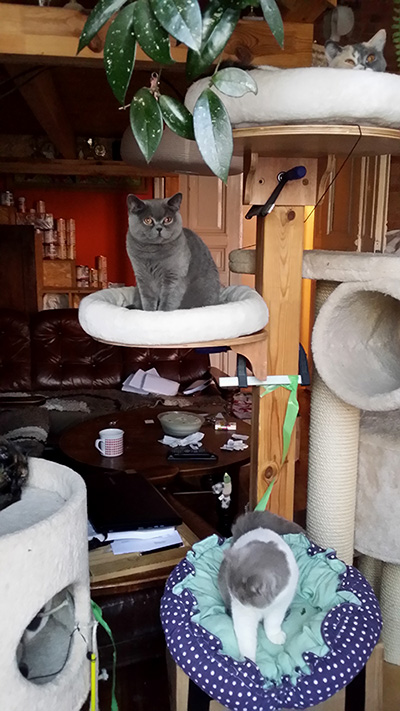
The photograph on the right provides a small illustration of everything I have written about. Once again, I modified one of my cat trees. Beside my armchair stood a small structure with a rosette bed and a shelf. It is still there, of course. The rosette is Gatty's beloved place, allowing her to remain close to my head while I work.
Vesper discovered the rosette only recently, even though two other rosette beds are suspended from the post beside my armchair. This is a strategically important location for the cats, so there are four rosette beds around my chair.
When I saw Vesper approaching Gatty with her head lowered in a conciliatory posture, offering her head for grooming and adopting an almost kitten-like body position, Gatty allowed her to enter. After Vesper's head and ears had been groomed, she settled beside her. They remained there together.
Unfortunately, I did not interpret this as evidence of some extraordinary mother-daughter feline love. I saw two cats that were both reluctant to use overt conflict to resolve competition over a highly valued location. I therefore removed a rosette bed from another cat tree where it was rarely used — clearly an inferior location according to the cats — and attached it to the post above my head.
Since then, there has been no dramatic display of mother-daughter love and no squeezing together into one small bed. Instead, there are two cats stretched out luxuriously, lying belly-up in separate rosettes beside my head. Sometimes there are more of them, as in the photograph, because proximity is important and every cat wants to be near me while I work in my armchair.
So the girls arrange themselves in a circle around my head: inside the box, on top of the box, in the rosette beds and in the hammock — also positioned above my head, although it is not visible in the photograph.
And that is what I wish for everyone.
________________________________________________________
Dorota Szadurska, COAPE Behaviourist Supervisor
Graduate in Advanced Diploma in Feline Behaviour Management (Level 5, UK)
Member of The International Society of Animal Professionals
Member of The International Association of Animal Behavior Consultants