Dorota Szadurska, Feline Behaviourist and Behavioural Therapist: My Qualifications
It all began with breeding — there is no doubt about that. But that was only the beginning :)
And so, eventually, I became a practising behaviourist specialising in feline behaviour. Until relatively recently, cats were generally perceived as animals that lived alongside humans rather than truly with them. The place beside humans belonged almost exclusively to the dog, whose position seemed entirely unchallenged. Yet what once appeared unlikely has gradually become reality. Cats are no longer regarded merely as useful companions sharing our environment; increasingly, they are recognised as full members of our families — individuals for whom we change our preferences, routines and even our way of life, sometimes despite the inconvenience this may involve. Cats are also gradually ceasing to be viewed as solitary animals with no need for human companionship. Quite the opposite: many actively seek human proximity and readily settle on a welcoming lap whenever one becomes available.
Unfortunately, as is so often the case, increasing popularity does not necessarily translate into optimal welfare. Although we all love our cats, we do not always fully understand their behavioural and environmental needs. This is hardly surprising. Cats are still widely perceived as "low-maintenance" animals — an apparently "easier option" when compared with dogs, largely because they do not need to be taken for walks. Yet cats are highly sensitive animals, and their ability to cope with prolonged or repeated stress should never be overestimated. When stress becomes chronic and the cat's coping capacity is repeatedly exceeded, it may contribute to a range of health and behavioural problems, involving both physical health and emotional wellbeing, including profound behavioural withdrawal and depressive-like states.
The earliest signs that a cat is struggling to maintain behavioural and emotional stability can be extremely difficult for caregivers to recognise. This is partly because they may initially involve an increase in otherwise normal feline behaviours, such as grooming or elements of predatory behaviour, or, conversely, a gradual reduction in general activity that is frequently attributed simply to ageing. Over time, however, these changes may develop into compulsive behaviour, stereotypic behaviour patterns, aggressive behaviour, marked apathy or depressive-like states. By the time the problem has become clearly visible, identifying the original trigger or underlying cause can be extremely difficult.
A behaviourist is someone who tries to help caregivers view the world surrounding their cat from the cat's own perspective. Of course, in reality, we cannot truly see the world even through the eyes of another human being, let alone claim absolute certainty about the subjective experience of a cat. A feline behaviourist can, however, explain what is genuinely important for feline welfare and help identify factors within the cat's physical and social environment that may affect its behaviour and emotional state. Unfortunately, many persistent myths about cats are still widely accepted, despite having very little to do with their actual behavioural needs or welfare.
A behaviourist cannot guarantee that every behavioural problem will be completely resolved. Behaviour is complex, and its development and maintenance may involve multiple interacting factors. However, behavioural assessment and appropriate intervention can create an opportunity for better communication and understanding between cats and their caregivers. With good cooperation, consistency and a genuine willingness on the part of caregivers to introduce necessary changes, the chances of achieving meaningful improvement can be very high.
I have been working with cats at different stages of life for 23 years, both individually and in mixed-age groups, and have experience with cats at virtually every stage of development. For the past 17 years, I have been teaching caregivers how to better understand the subtle and often hidden world of feline behaviour, helping them improve their relationships with their cats and address behavioural problems that can arise even in the most loving and well-established human-cat relationship.
As regular visitors to my website already know, I share my everyday life with my own feline family, whose members span a wide range of ages. Until relatively recently, this included newborn kittens whom I accompanied through the critical stages of early development and socialisation; today, it includes feline seniors aged 17 to 19. Every one of my cats has a different personality. Every one of them has taught me something different. Above all, they have taught me never to forget that they still have a great deal to tell me!
Dorota Szadurska, COAPE Behaviourist Supervisor
Graduate in Animal Psychology, Polish Academy of Sciences, Warsaw
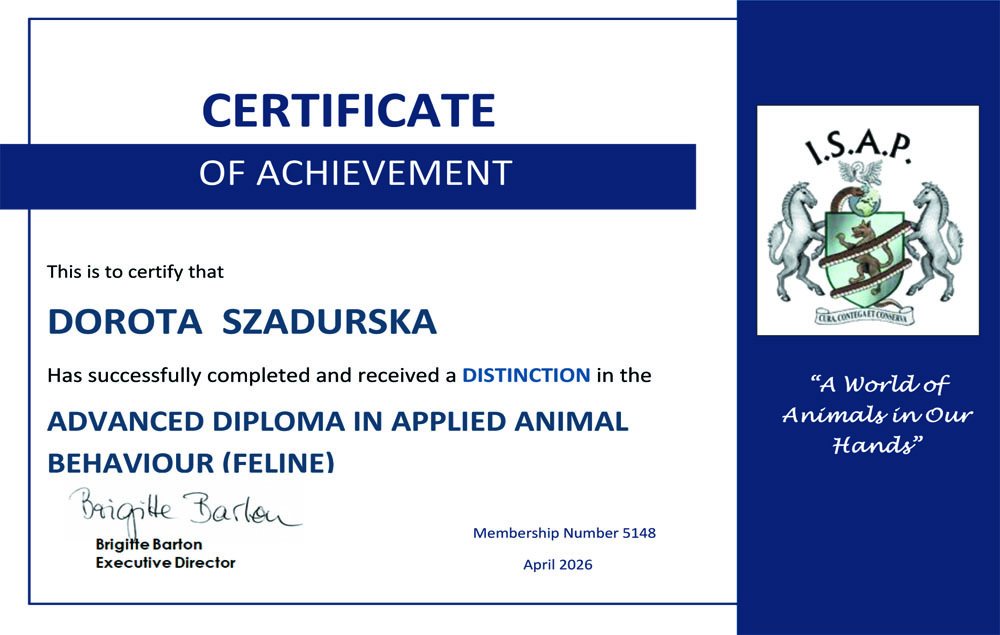
Graduate in Advanced Diploma in Feline Behaviour Management (Level 5, UK)
Graduate in Companion Animal Care and Husbandry, Wrocław University of Environmental and Life Sciences
Member of the Polish Ethological Society (PTEtol)
Member of The International Society of Animal Professionals
Member of The International Association of Animal Behavior Consultants