Cat Scratching Posts: How to Choose the Right Scratching Post
A scratching post is as personal a matter for a cat as choosing cosmetics is for us. It serves many different functions. We humans tend to think of a scratching post primarily as something intended to protect our furniture from feline claws, and we often mistakenly describe it as a place where cats "sharpen" their claws. In reality, a scratching structure is an extremely important element of the feline environment. It fulfils several key behavioural functions, and its absence or inappropriate design may contribute to significant behavioural and welfare problems.
When a cat scratches a post or any other surface, it leaves both visual and olfactory signals. Scent secretions associated with the interdigital region of the paws contribute to this form of chemical communication. An environment containing the cat's own familiar scent signals may be perceived as more predictable and secure, supporting emotional stability and reducing uncertainty.
In fact, a cat does not "sharpen" its claws during scratching in the same way that we sharpen a knife. Scratching helps remove the worn outer layers of the claw sheath, exposing the newer, sharper claw beneath. This primarily concerns the claws of the forelimbs. Cats commonly remove worn claw sheaths from the hind feet using their teeth — something that almost every experienced cat caregiver has probably had an opportunity to observe.
Scratching also involves extensive stretching and muscular activity of the forelimbs, shoulders and body. It contributes to the normal use of the musculoskeletal structures involved in extending and retracting the claws — functions that remain important in everyday feline behaviour.
A scratching post is therefore neither a luxury nor an expensive toy. It is an essential component of the cat's environment, regardless of whether the cat is pedigree or non-pedigree. A domestic cat adopted from a rescue organisation or taken directly from the street has exactly the same fundamental behavioural need for appropriate scratching opportunities. However, if a scratching structure is to be accepted and used by the cat, it must meet several important requirements.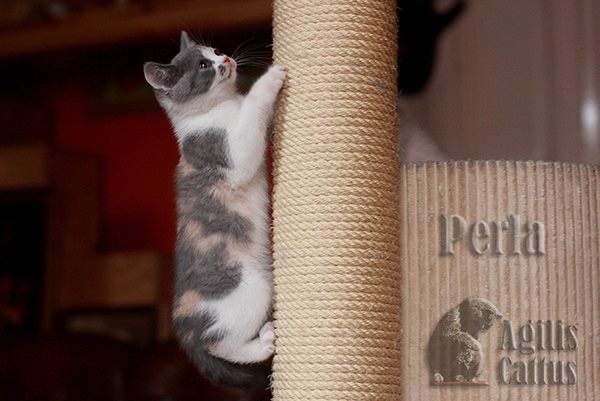 First, stability. Cats generally dislike unstable or wobbling structures. A scratching post must be secure and stable. In the case of freestanding posts or larger structures incorporating enclosed resting areas or beds, the base is particularly important. It must be sufficiently wide, heavy and stable.
Second, the scratching post must provide an appropriate vertical height or horizontal length. A cat can often tell us what dimensions are ideal. If the cat already has a favourite scratching location, simply observe the cat and measure the height or length of the area being used. A vertical post approximately 70 cm high is, in my opinion, the minimum required to allow most cats to stretch comfortably, although genuinely large cats may require considerably more.
Cats also vary greatly in the way they scratch. Some extend their bodies upwards to their full length, while others scratch only at approximately shoulder height. The appropriate height of the post therefore depends partly on the individual cat's scratching posture and behavioural preferences.
The post should not be too narrow. The greater its diameter, the more comfortably many cats can brace themselves against it and stretch during scratching. A diameter of approximately 14 cm is my preferred minimum — or, perhaps more accurately, the minimum preferred by my cats :)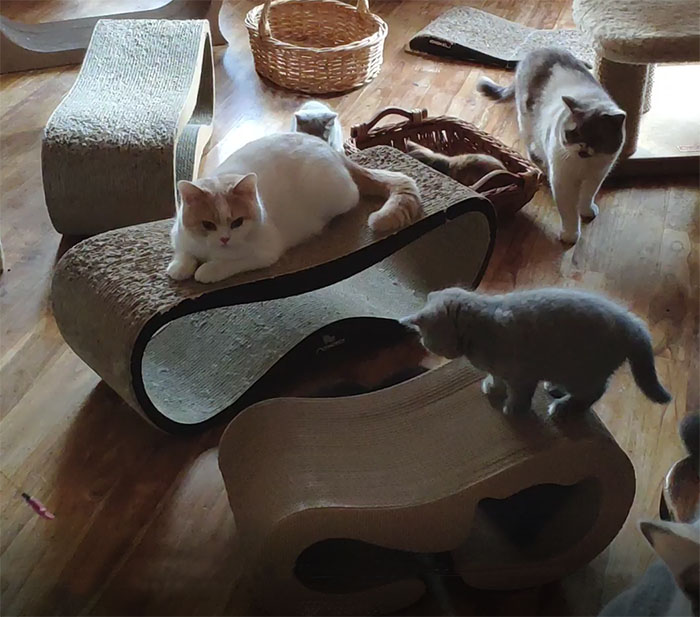 It is worth observing a cat carefully during the first days after arrival in a new home. Pay attention to the surfaces and locations selected for scratching. The cat is constructing its own functional representation of the home environment according to its behavioural needs.
If the cat selects a location that, for some reason, we consider unacceptable, we need to find a compromise. No attractant or deterrent will provide a reliable long-term solution if we simply prevent the cat from scratching a chosen location without providing an alternative that is equally or more behaviourally attractive. That is precisely what I mean when I use the word "compromise".
Clara loved scratching the back of one of our old armchairs. I wrapped the rear of the chair in sisal rope, and she was extremely satisfied with the arrangement. Sisal rope subsequently appeared in several other locations that could easily be wrapped and converted into scratching surfaces without adding another large piece of cat furniture.
Naturally, shops offer an enormous range of ready-made scratching structures incorporating enclosed resting areas, shelves and comfortable beds, and these are also the main type of scratching structures used in my home. However, small modifications to existing furniture can sometimes prove considerably more effective than an elaborate new piece of cat furniture.
The location of a scratching structure is enormously important from the cat's perspective. A cat may show little interest in a scratching post pushed into an isolated corner. Ideally, the structure should be accessible from several directions and positioned in a strategically important location within the cat's functional environment.
A stable scratching structure equipped with solid, comfortable platforms can very quickly become one of the cat's favourite locations for resting and observing household activity. If it is incorporated into a connected movement route consisting of shelves and existing furniture, it may become a central point from which the cat begins its journeys through the three-dimensional environment.
When purchasing a ready-made scratching structure, particular attention should be paid to its construction quality. A small kitten grows remarkably quickly and may soon weigh five kilograms — or, in the case of some adult males, seven kilograms or more. A Maine Coon may, of course, be considerably heavier. The scratching structure must therefore be robust.
I recommend immediately rejecting structures with very narrow support posts, even if they initially appear strong and stable. The base should be wide and heavy. In my opinion, support posts should have a minimum diameter of approximately 12 cm, with 14 cm being preferable. Posts of this diameter, wrapped in relatively thick rope, are not only more stable but can also be visually attractive.
For an adult cat, my recommended minimum platform size for resting is approximately 60 × 40 cm. An adult male Maine Coon may, naturally, require something larger :)
Round or oval beds — sometimes referred to as rosette beds — are extremely popular with many cats. In my experience, a diameter of approximately 40 cm is a reasonable minimum for an average adult female and approximately 50 cm for a larger male.
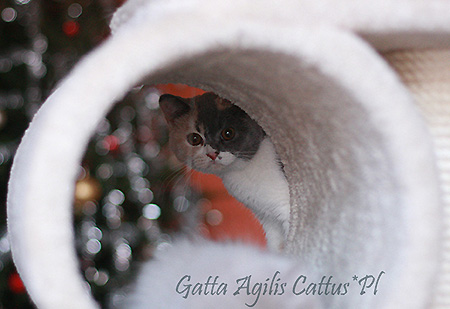
In addition to a traditional flat platform or round rosette bed, a circular tube can work extremely well as an elevated resting location on a scratching structure, as shown in the photograph. A curved half-tube or trough-style bed can be equally successful. Many cats appear to enjoy resting surfaces with rounded or supportive edges.
I generally recommend purchasing relatively simple scratching structures rather than excessively elaborate constructions — but having more of them. A very large, complex cat tree offers relatively little flexibility when we need to change its position. Several simpler structures can be rearranged, connected or separated according to the cats' current needs. This is particularly important in households with more than one cat.
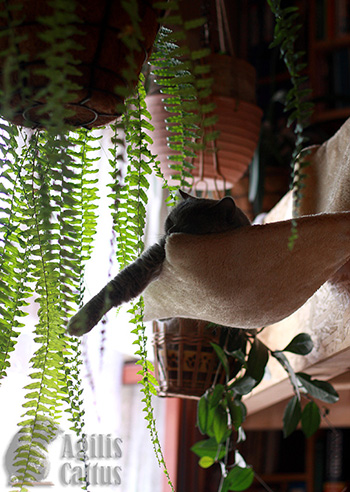 It is also advisable to determine which types of surfaces the cat actually prefers before investing in particular accessories. We often pay for elements of scratching structures that our cats subsequently refuse to use.
For example, observe whether the cat is comfortable on unstable, flexible or uneven surfaces. Not all cats use hammocks. Some clearly prefer to feel a firm, stable surface beneath their paws :) Other cats absolutely adore hammocks, and for those individuals a hammock can be an excellent addition to a scratching structure.
Naturally, as with almost everything involving cats, location matters. There was a time when I would have said that my cats simply did not like hammocks. That conclusion proved completely incorrect after I moved the hammocks to different locations. I subsequently had to increase their number quite dramatically to prevent competition and disputes :)
An enclosed resting compartment on a cat tree should generally not be positioned too close to floor level. If it is located directly at floor height, many cats may ignore it — although, as always with cats, we can certainly find individuals who will consider such a location absolutely perfect.
I also find that cats are often more willing to use an enclosed compartment when it has two openings, although this is certainly not a universal rule.
The arrangement of platforms also requires careful consideration. We often want a cat tree to occupy as little floor space as possible and therefore choose a very tall but narrow structure. However, if the platforms do not form functional "steps", the cat may repeatedly jump from a considerable height.
For a large, heavy adult British Shorthair or Maine Coon, repeated high-impact landings may be undesirable. They can become particularly problematic for large cats, older cats and individuals with existing musculoskeletal disease or reduced mobility, regardless of age.
Ideally, a scratching structure should be incorporated into a connected route between furniture or wall-mounted shelves. This allows the cat to create a functional three-dimensional world within our home — an environment through which it can move, explore and observe its surroundings from above.
This type of environmental organisation can be particularly valuable for fearful or cautious cats. Access to elevated observation points and connected escape routes may allow a cat to assess an unfamiliar stimulus from a position of relative security rather than immediately panicking and fleeing into another room when, for example, the doorbell rings.
In my home, the first scratching structures were entirely homemade, and my first cats did not destroy any of our furniture. Achieving this required a certain amount of compromise on both sides, but I believe it was well worth the effort.
As the number of cats in our household increased, professionally manufactured scratching structures began to appear. They were undoubtedly good purchases and are extremely popular with the cats. Nevertheless, I am delighted that our old homemade inventions have by no means been forgotten. To this day, the cats use them for scratching alongside the commercially manufactured structures.
A scratching post is not simply a way of protecting our furniture. More importantly, it is a strategic component of the cat's environment: a resting and observation location, a site for visual and olfactory marking, and a resource that can contribute to environmental familiarity, predictability and a sense of security.
For this reason, regardless of the number of cats living in our home, there should never be only one scratching resource. Nor should a scratching structure stand as an isolated "island" from which the cat has nowhere else to go.
We should regard scratching structures as part of our interior furnishings. It is often false economy to buy something that we subsequently hide in a corner because we dislike the way it looks. Some scratching structures are genuinely beautiful pieces of furniture. If selected carefully and positioned appropriately, they can become both an attractive part of the room and a resource that cats use enthusiastically.
And one final, very important point: with every additional cat, we should also introduce additional scratching resources into the home. I discuss the importance of the appropriate selection, number and positioning of scratching structures in greater detail in the Cat-Friendly Home section.
Dorota Szadurska, COAPE Behaviourist Supervisor
Graduate in Advanced Diploma in Feline Behaviour Management (Level 5, UK)
Graduate in Animal Psychology, Polish Academy of Sciences, Warsaw
Graduate in Companion Animal Care and Husbandry, Wrocław University of Environmental and Life Sciences
Member of The International Society of Animal Professionals
Member of The International Association of Animal Behavior Consultants
Member of the Polish Ethological Society (PTEtol)