A Safe Home for Your Cat.
Our home, although for us it is a haven of safety, may turn out to be a place full of traps and dangers for a cat. Please take a moment to check whether our feline child is truly safe with us.
Securing Windows and Balconies
We usually mean installing a mesh in the windows, but many caregivers still forget about properly securing tilt windows.
I am surprised how often, when I mention window or balcony mesh—an element I consider indispensable in any home with a cat—it is met with astonishment. Meanwhile, window mesh is like seatbelts in a car: we may never need them, but that one time, even through no fault of our own, we may have an accident, and they can save our lives. A well‑installed, solid window mesh serves the same purpose. There is no such thing as “suicidal cats” (I once heard this said about a cat who fell out of a window three times and had his spine and pelvis treated three times). An adult cat knows perfectly well how high it is and that jumping from such a height is impossible. Unfortunately, cats have a very strong hunting instinct, and if a bird flying nearby seems catchable, they may simply forget where they are—and the jump becomes their last. Do not rely on the belief that your cat is not interested in the outside world, that it only looks, that it never goes beyond the inner windowsill. It is only a matter of time before some stimulus becomes attractive enough to make the cat try walking along the balcony railing or the outer windowsill.
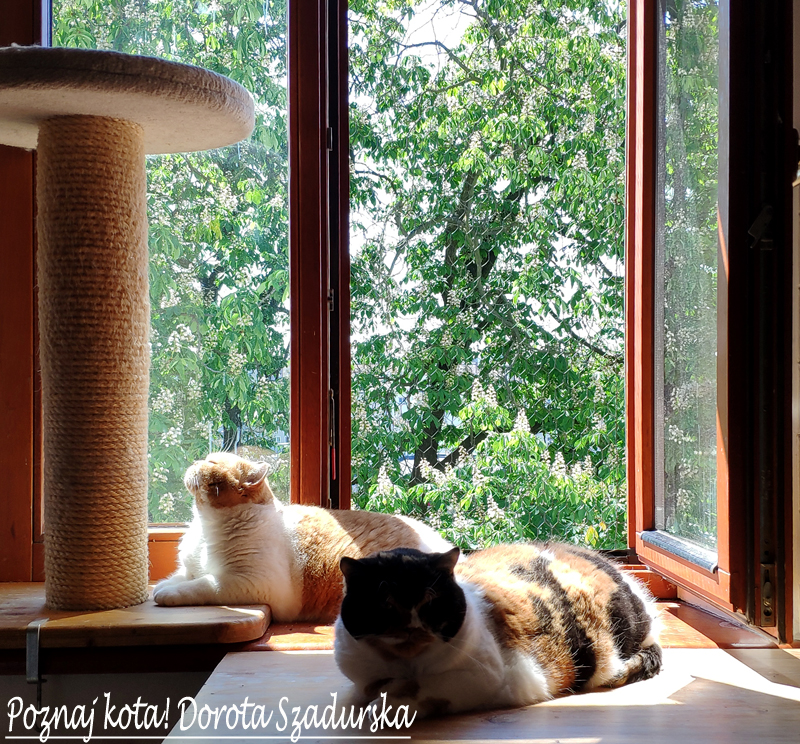
I am not encouraging anyone to “ruin” the look of their home with a cheap plastic mosquito net. Today, the market offers many materials that can be used to create a truly aesthetic, almost invisible additional window element. In the photo next to this text, I show my own window—the mesh installed there is garden mesh, dark green; if someone visiting doesn’t know I have mesh in the windows, they don’t notice it at all. In the photo on the right you can see my kitchen window, with two girls sunbathing; I assure you, there is a solid wire mesh in that window :)
Caregivers often believe that if windows are tilted, this alone protects against falling out. This is only true when the windows are set inside a surrounding wall right next to the frame, which itself acts as a barrier preventing access to the gap. In other cases, tilt windows can become a deadly trap for a cat. This applies especially to young kittens, who can very skillfully climb the window frame, and if they manage to squeeze their head into the gap at the top, they slide down and wedge their torso or head. These accidents rarely have a happy ending—unless we happen to be at home and manage to help the cat in time. I never tilt my windows at all, because thanks to the mesh I can simply open them wide, and the cats love sitting on the windowsills and watching the world. What tilting windows can lead to is shown in the video on the right—those who cannot watch until the end, I assure you that this particular cat was fine. Unfortunately, I personally know homes where there was no happy ending.
A balcony requires similar protection. A balcony is a wonderful place for a cat, a perfect enrichment of daily life—provided it is secured. You do not always need to mesh the entire balcony. If it is truly large or has the form of a spacious terrace, it is enough to secure a part of it to which the cat will have access. I have seen many ideas, and window manufacturers are increasingly offering solutions that meet both our cats’ needs and our sense of aesthetics.
A Firm NO to Letting Cats Outdoors Unsupervised
As usual in such cases, I will likely meet many opponents, but my position remains unchanged: a cat who has a home must not be let outside unsupervised. I do not mean controlled access to a secured garden or aviary, but free roaming without supervision. A cat absolutely should enjoy the outdoors, but in a controlled and safe way. This may be a fenced part of the garden, or a fully secured garden. What we must not do is let cats roam freely.
* Most freely roaming cats sooner or later, unfortunately, die under car wheels. A cat’s defensive strategy—first hiding and waiting for danger to pass—is in this case the cause of their death.
* Diseases, including some deadly ones such as FeLV or FIV, for which there is no cure and which cats contract through direct contact. Believe me, there is nothing more terrible than watching the slow death of someone who has become a member of our family, and euthanasia, although it may shorten the cat’s suffering, does not ease our guilt or helplessness.
* Let us respect our neighbors. Our cat may enter their yard and, for example, use a sandbox intended for children as a toilet, or start intimidating their cats, which may then develop various behavioral problems out of fear of the “intruder.”
* Let us also be aware that our unsupervised outdoor cat is not “on vacation”—it encounters many emotionally negative situations: an unfamiliar unfriendly cat, an unfriendly dog, an unfriendly human. All these emotions will be released at home, taken out on another cat, dog, or child. This is a very common pattern.
Things that do not always look dangerous, but...
It is good to look at our home from a cat’s perspective, especially from the perspective of a small kitten. Are there narrow spaces in the home where a kitten could squeeze in and get stuck? Is the fireplace opening closed so the cat cannot climb into the chimney? It is good to inspect our home before bringing a cat in, so we are not surprised by the creativity of our new household member. Below are some of the most important points of everyday life that may seem harmless but can be dangerous for a cat:
* Toilet: always remember to close the toilet lid. Kittens like to look inside, and if they fall in headfirst, they may drown or, at best, be severely poisoned by the chemicals we usually use to keep the toilet clean.
* Washing machines, fridges, dishwashers, ovens—cats love hiding in them for some reason, so we must absolutely keep these appliances closed, and if they were open for some time, we must check before closing whether a cat is inside. If household members are forgetful, you can stick “reminder notes” on the doors of all appliances that may become traps.
* Chemicals, cleaning agents—everyone knows these substances must be kept out of reach of animals. Less attention is paid to the fact that if we wash the floor with chemicals, we should avoid letting the cat walk on it—by licking its paws, the cat “eats” all those wonderfully cleaning substances. Hard‑to‑diagnose digestive problems, not to mention more serious conditions, may originate from this kind of chronic poisoning. I stopped using strong chemicals; I mostly use a steam mop. The floors may not be as shiny as in commercials, but I have never had digestive issues in my cats.
* Medicines must also be kept out of reach, especially since some of them, harmless to us—like aspirin or paracetamol—are highly toxic to cats.
* Windows—described above, so I will not elaborate, but for completeness I remind you to secure them properly. I repeat: cats are not suicidal, but the impulse of a bird flying close or even an ordinary fly may be irresistible.
* Plastic bags—cats love hiding in them, love climbing inside, and expose themselves to many dangers: we may not notice them and sit on them or step on them, and the greatest danger, especially with large bags or sheets of plastic, is suffocation. I know the sight of a cat peeking out of a bag is very funny, but remember not to leave empty plastic bags or sheets lying around (the latter are much more dangerous!). Cleaning up plastic scraps is extremely important, because swallowing them becomes a direct threat to the cat’s life.
* Plants. Many plants are harmful to cats; some are even toxic and can cause serious illness or, in extreme cases, death. Popular dangerous plants include:

- Lilies and lily-like plants
- Alocasia sp.
- Aloe
- Azalea
- Dieffenbachia
- Dracaena
- Ficus
- Geranium
- Hydrangea
- Common ivy (many varieties)
- Privet
- Daffodil
- Ornamental tobacco
- Philodendron
- Rhododendron
- Garlic
- Boxwood
- Cyclamen
- Lily of the valley
- Lupine
- Oleander
- Tomato (only the vine part!)
- Poppy
- Primrose
This list is longer; I provide only the most common plants found in our homes and gardens. This does not mean we must get rid of all our flowers. Most of them, such as potted plants, simply need to be kept out of the cat’s reach. However, remember that eating some of these plants is very dangerous (lily leaves are especially toxic—their ingestion can very quickly lead to severe kidney damage and, consequently, failure and death).
Dorota Szadurska, COAPE Behaviourist Supervisor
Graduate in Advanced Diploma in Feline Behaviour Management (Level 5, UK)
Graduate in Animal Psychology, Polish Academy of Sciences, Warsaw
Graduate in Companion Animal Care and Husbandry, Wrocław University of Environmental and Life Sciences
Member of The International Society of Animal Professionals
Member of The International Association of Animal Behavior Consultants
Member of the Polish Ethological Society (PTEtol)